Compute credit is tightening. Residual value hedges are here for borrowers and lenders.
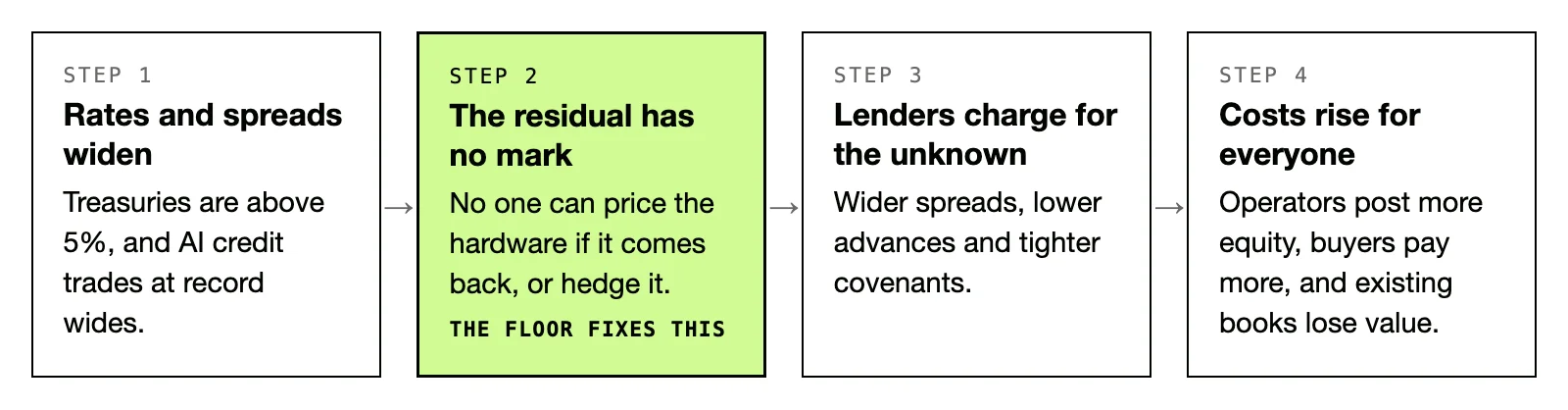
Compute credit is tightening, and the unpriced residual now sits in everyone's cost of capital. A floor on the compute rate prices it, for new deals and existing books.
If you’ve been told your advance is lower than in August, that you need more equity, or that funding is harder to find, you’re not alone. If you’re a lender wondering how to hedge the residual value of a GPU book, you’re not alone either.
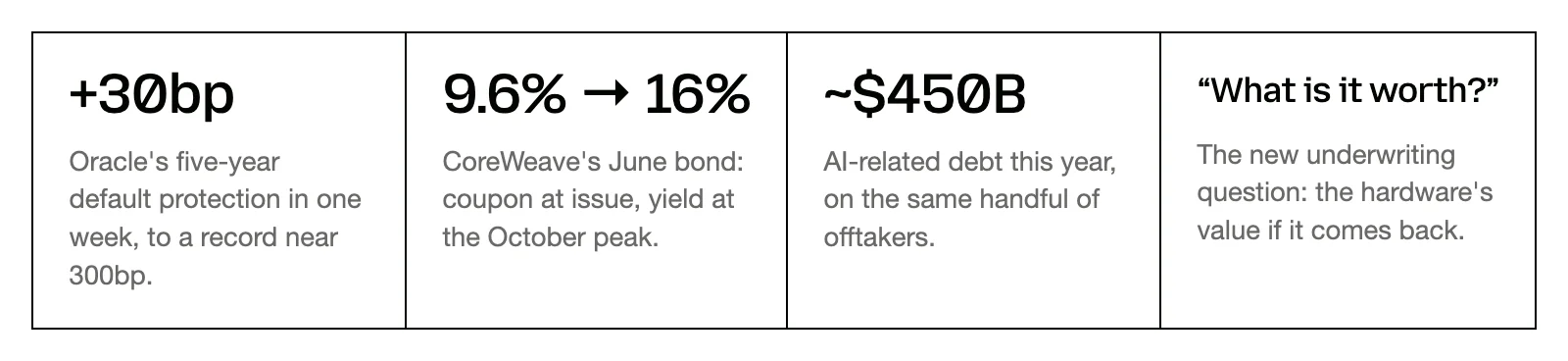
The cost of insuring the debt of Oracle, an investment-grade hyperscaler, rose about 30 basis points in a week to a record, with Amazon, Alphabet and Meta at record wides too, and CoreWeave's June bond, issued at 9.625%, has traded as high as 16%. As Stanley Lee wrote in The compute credit cycle just turned, lenders now underwrite the operator and ask what the hardware is worth if it comes back. There is no market answer yet, so that unknown sits in everyone's cost of capital. A floor on the compute rate prices it, on new deals and on books already written.
How the residual raises everyone's cost of capital
The crunch puts hedgers on both sides of the same rate
Stanley's note called this cycle healthy, and this is part of why: the same squeeze that makes lenders, lessors and operators want a floor makes buyers want a cap. A hedging market needs exactly that, two groups who each want the other's risk.
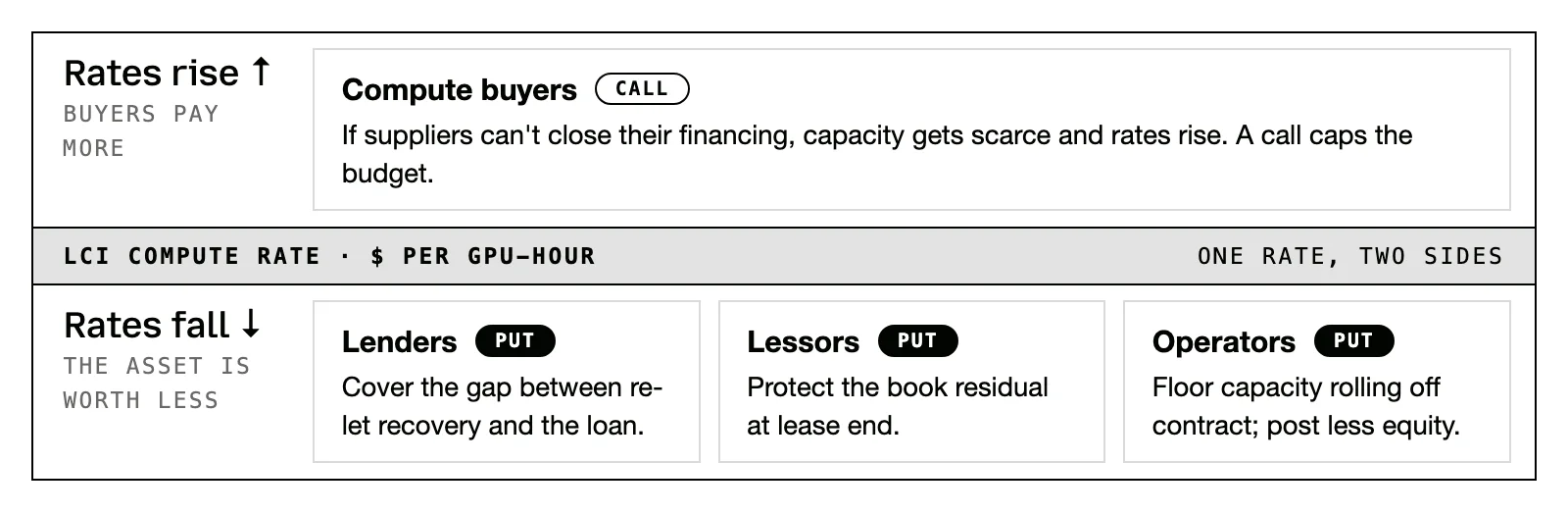
Each hedge references the LCI for its own chip: A100, H100, H200, B200 or B300.
A floor moves the advance from 65% to 85%
A floor caps what a lender can lose if compute rates fall, so it can lend more. On an illustrative $15M cluster, it lets the lender advance 85% instead of 65%. The operator puts in $3.0M less equity.
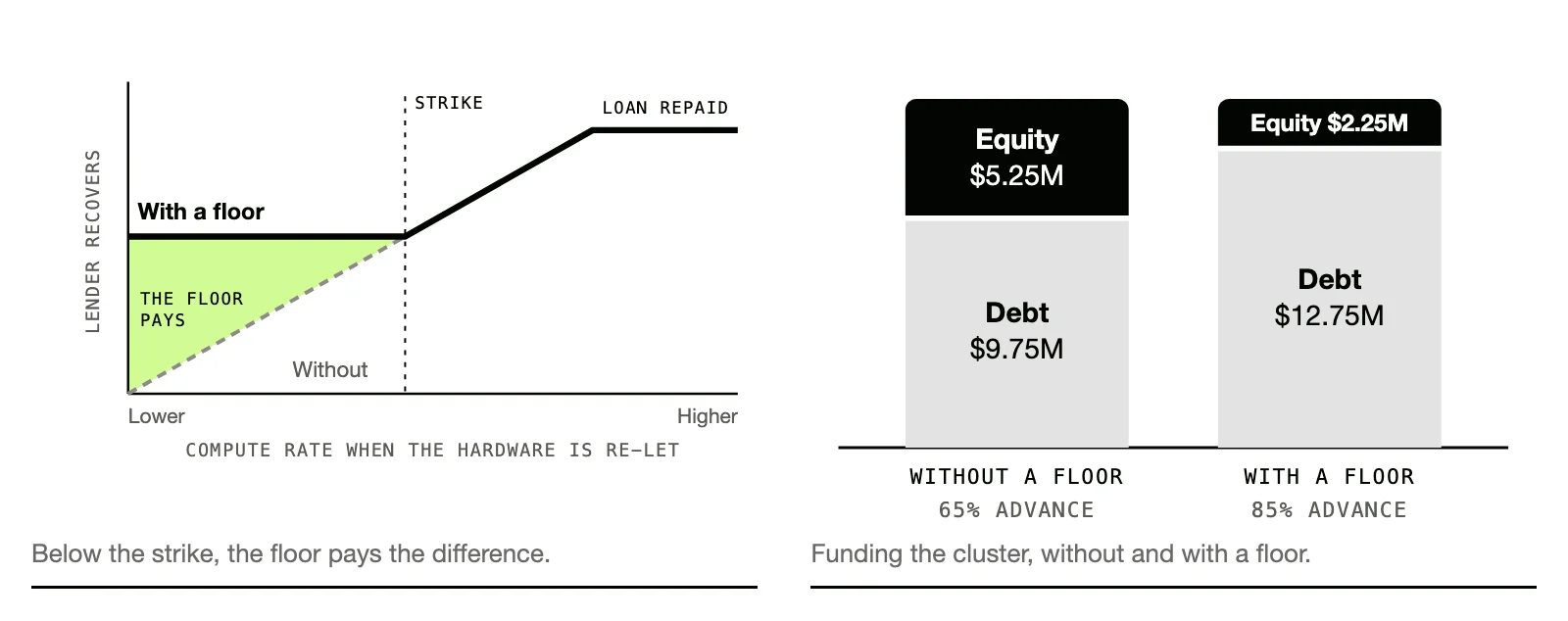
Illustrative. The put covers 40% of the loan, struck out of the money. Premiums are set by the liquidity provider for each deal.
For the operator, the floor pays for itself: cheaper funding saves about $0.45M a year, and the floor costs about $0.17M a year ($0.51M upfront over three years).
Run your numbers, send the ticket
Make a free account on liquidcompute.com and turn your advance, residual, breakeven or budget into a quotable ticket in the Hedge Converter. Our primer, Hedging compute rates, walks through all four.
Hedge one deal or a whole book: a deep out-of-the-money put sized to a portfolio of GPU loans or leases caps the loss in a sharp drawdown for a small running cost, the way a credit fund buys index protection.
No premium? A forward or swap locks the rate at no upfront cost, in exchange for the upside.
Talk to us
If a financing has stalled on the advance, the residual or the equity check, a floor is usually the missing piece, and we can get one priced in days. If you're a lender with a GPU book, we can put a mark on it and a hedge around it. Either way, write to lending@liquidcompute.com while capital is still available.
Sources: Oracle and hyperscaler default protection, Reuters, “AI credit worries send default insurance to record high,” October 15, 2026, citing LSEG and S&P Global Market Intelligence. CoreWeave, Treasury and AI-debt figures, Stanley Lee, The compute credit cycle just turned, Liquid Compute, October 14, 2026.
Published by Liquid Compute Research for informational purposes only. This note is not an offer, solicitation, recommendation to lend, arrange financing or transact, and is not investment, legal, tax or accounting advice. The options described here are over-the-counter transactions between the hedger and third-party liquidity providers, available only to eligible contract participants, and are not listed or cleared on any exchange. Liquid Compute is never a counterparty to these transactions and does not take positions on its own index. Examples are illustrative, not real trades. The derivatives exchange is pending CFTC designation as a DCM and registration as a DCO.