The compute credit cycle just turned, and why that's a good thing.
The offtaker contract is still most of the credit, but for the first time it isn't all of it. Who the operator is now moves the price, and that's good.
I spent nine years in high yield and distressed credit, Barclays to Point72, before I came to Liquid Compute to build the credit and markets side of compute. A lot of people have asked me this week what I make of CoreWeave, so I'm writing it down once. If I could pick one thing I've written for people in this market to read, it's this. It's longer than usual because the topic deserves it. Stay with me.
CoreWeave's June bond came with a 9.625% coupon. It closed yesterday at 15% and traded down another five points today to 16%. Volta's $5 billion loan is being talked at 625 to 650 over SOFR with a 97 to 98 issue price, call it 11.5%, the banks kept about a quarter of it, and the accounts being shown the rest are saying they're full. Hyperscaler CDS is at record wides. The 10-year's over 5.2%. Everyone with an X account now has a take on whether AI is a bubble.
Here's mine. Most of what's happening is a normal credit cycle. The part worth paying attention to is that the offtaker contract is still most of the credit, but for the first time it isn't all of it. Who the operator is now moves the price, and that's good.
One thing before the detail, for the inference companies and AI labs reading this, because I think this is your moment more than anyone's. The crunch starts with the neoclouds because they're holding the debt, but it ripples. Some operators you've contracted with will have trouble closing their financing, and lenders are going to look at the buyer behind the contract as carefully as the operator in front of it. That's not a threat. It's a sorting mechanism, and it sorts on something you control. The inference companies that come out of this ahead will be the ones with more than one way to pay for compute. Prepayment financing, vendor credit, more than one supplier, contracts a lender can take assignment of. Set that up now while capital's available and you'll be buying capacity next year while competitors wait on a round. Capital structure is about to become a competitive advantage in inference, and almost nobody is treating it like one yet. That's what we help with, and I'd rather have that conversation this month than in March.
First, separate the pieces
Four things are going on at once and people keep blending them into one scary number.
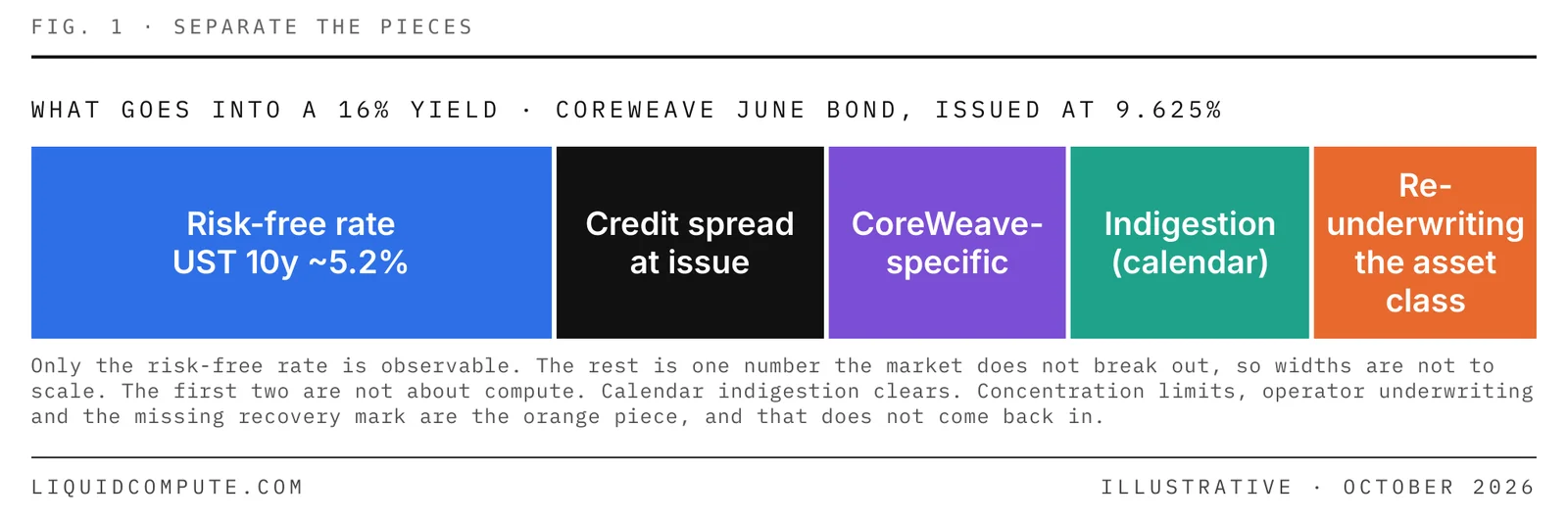
Rates have moved. The 10-year's at 5.2% and the long bond is at 5.6%, which was unthinkable a year ago. A third of every yield you're looking at is the risk-free rate. Treasuries did that, not GPUs.
Then there's CoreWeave itself. Some of that 16% is just CoreWeave. $35 billion of debt, serial converts, two customers behind most of the revenue. That's an issuer story, and I'd be careful using it to make a point about the asset class. Volta's the cleaner read on that, and I'll get to it.
Then indigestion. Something like $450 billion of AI-related debt has come this year. When an account tells a bank it's full, part of that is a calendar problem, and I've watched it happen a dozen times in high yield. That part clears when the calendar clears, usually a quarter or two, and spreads come back in. But there's a second reason accounts are full, and it doesn't clear. Every GPU loan on their book is backed by the same handful of offtakers, so they've hit a concentration limit on five names without deciding to, and they can't diversify because there isn't anyone else to lend against yet. That's not a calendar problem. Concentration limits are underwriting.
And then re-underwriting, which is the one I care about. It's the concentration piece above, plus two more things: lenders are underwriting the operator and not just the contract, and they've realized nobody has a mark on what the hardware's worth if it comes back. Volta is a brand new issuer with one of the strongest offtakers in the market behind it, and it's being talked 75 to 100 basis points wide of where CoreWeave's July loan cleared, at a lower issue price. That's not indigestion, it's not CoreWeave, and it's not the offtakers getting worse. The big inference platforms all raised in the last two quarters at higher valuations. If offtaker credit were the problem, Volta would be the easy deal. That's lenders deciding the offtaker contract is still most of the credit, but not all of it. I've written about this over the past few months, going back to when CoreWeave's July loan flexed wide. The direction of the flex mattered more than the level, because it told you who was setting the price. Here's what I mean.
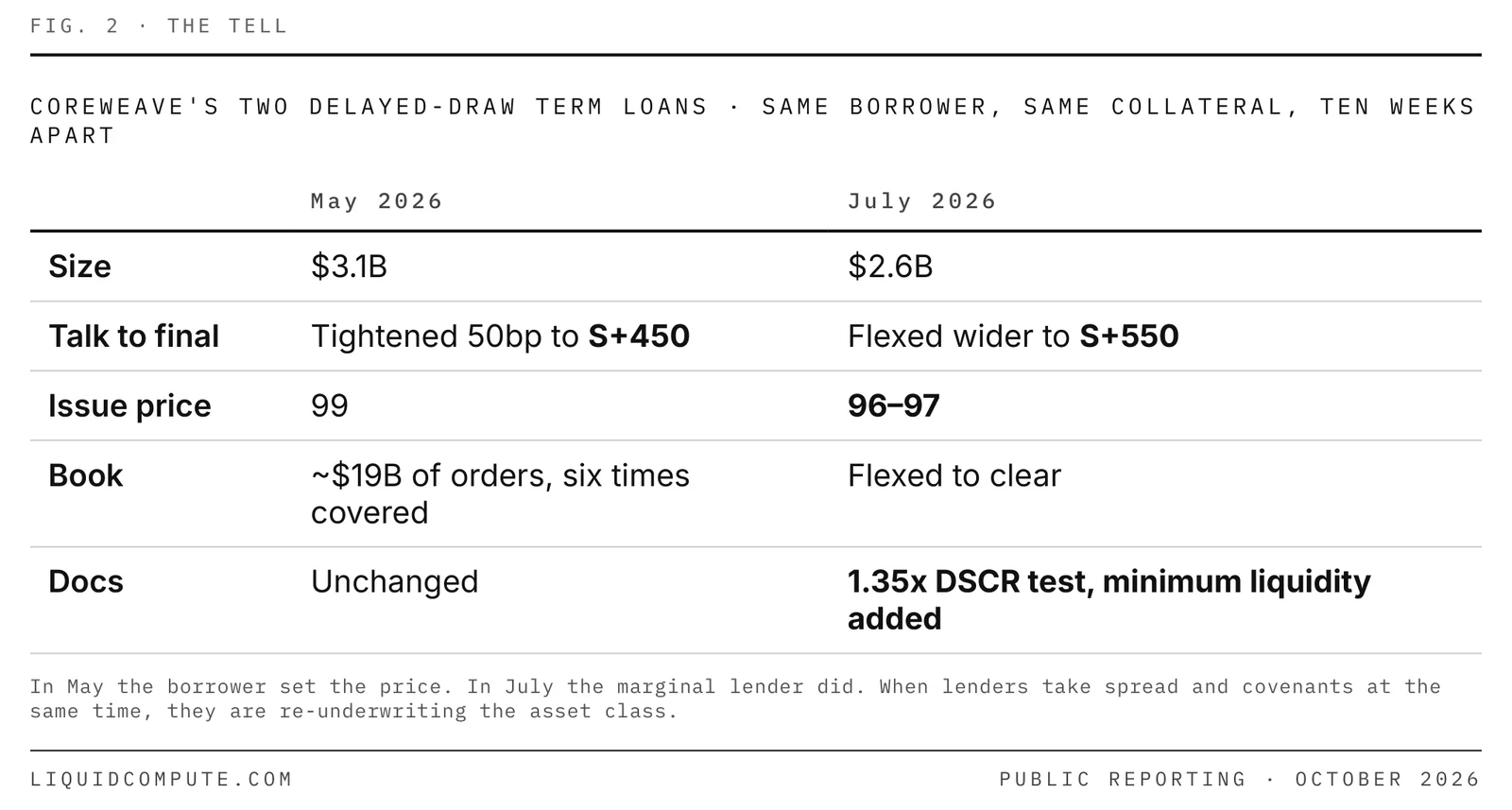
In May the borrower set the price. In July the marginal lender did. And when lenders take spread and covenants at the same time, they're not repricing risk. They're re-underwriting the asset class.
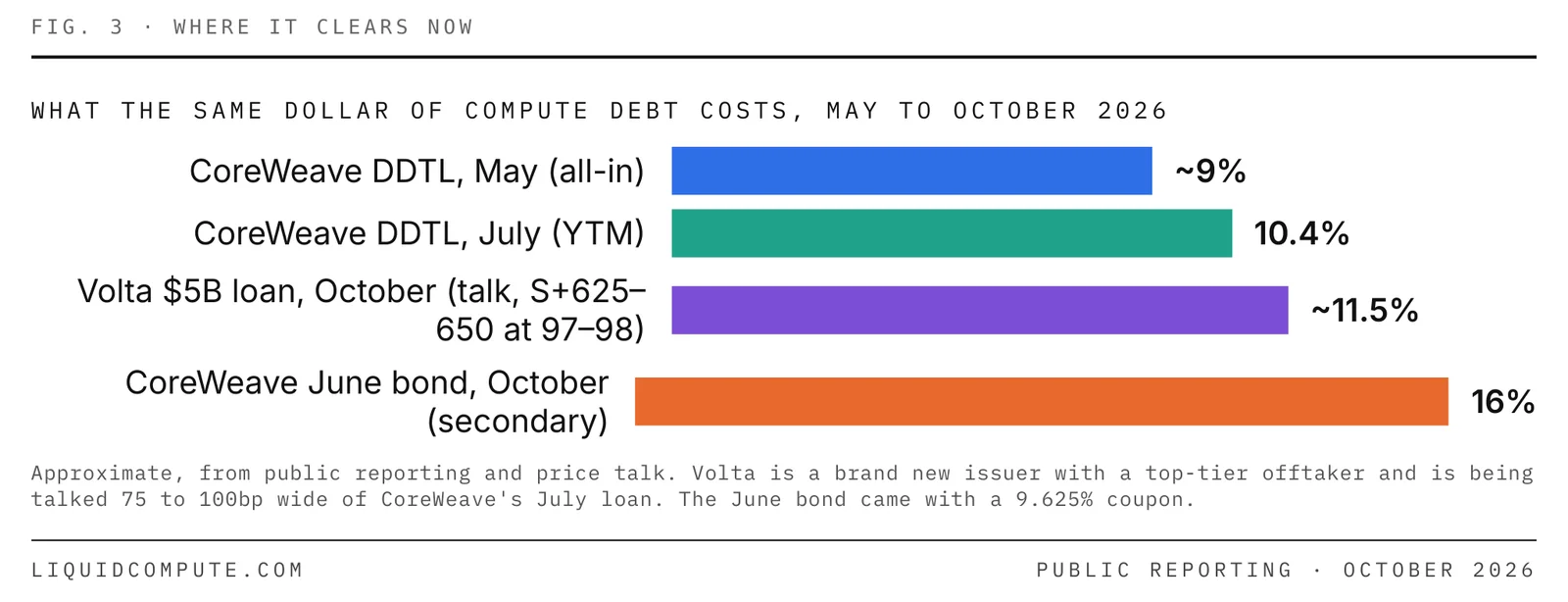
The four prints in Figure 3 are the direction of travel. Same asset class, five months, and every new deal clears wide of the last one.
Go back to Figure 1 for a second. Nobody can tell you exactly how much of that 16% is which of the four pieces. The market doesn't break it out and anyone who gives you a decimal is guessing. But you can tell which piece is growing, and it's the last one. Rates and CoreWeave aren't about compute. Indigestion half-clears. Re-underwriting is the new market, and the rest of this is about that.
Why lenders pulled instead of repricing
I want to be careful here, because the easy version of this is wrong. The easy version is that lenders suddenly discovered GPU loans are risky. Nobody has ever repossessed a GPU fleet and re-let it at scale, and the lenders who've been here a while have known that from day one. They priced it anyway, and for a while they were right to. The marginal lender who showed up in the spring chasing an offtaker name maybe didn't know, or didn't care, and the marginal lender sets the price. So two things happened at once: the core got full, and the tourists left.
What changed is three things at once.
- The supply kept coming, so the same lenders were asked to write the same risk again and again.
- Their books filled up on the same handful of offtakers.
- There's still no way to lay any of it off. No hedge on the residual, no hedge on the offtaker, no secondary market to sell into.
A lender who can diversify or hedge keeps quoting, just wider. A lender who can do neither stops. That's why some funds that were writing GPU-backed loans in the spring are out until they raise again, instead of 300 wider.
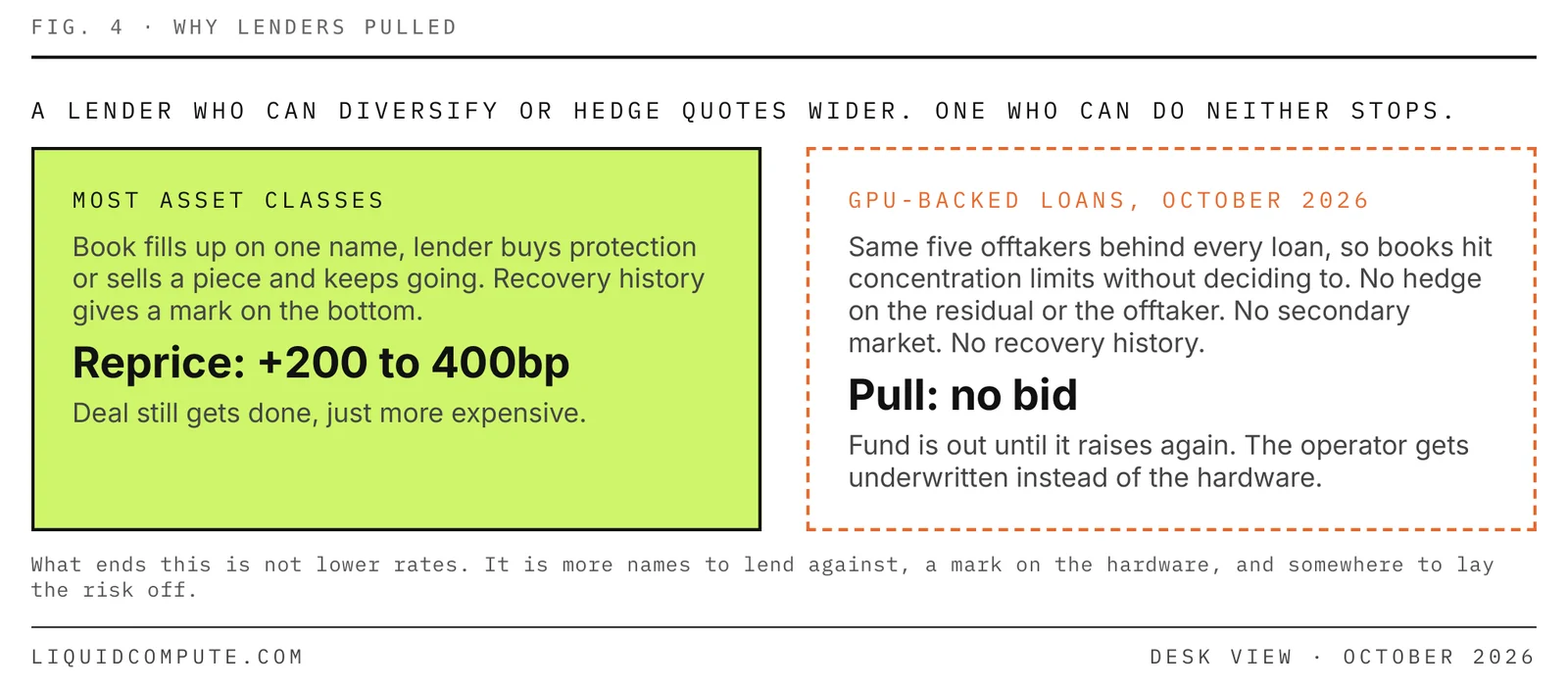
Which tells you what actually ends this, and it isn't lower rates. In order:
- Time, because the calendar part of indigestion clears on its own.
- More names to lend against, so books can diversify.
- A credible mark on what the hardware's worth at the end and a path to remarketing it, so the downside can be priced.
- Last, because it's hardest, somewhere to hedge the residual and lay the risk off.
We're working on the last three. Until they exist, the beatings will continue until morale improves. Lenders will keep underwriting the operator hard enough that they never have to find out what the hardware's worth, and operators will keep paying for it.
What that looks like from my seat
A lot of the conversations I'm having this month go the same way. An operator locked up offtake and supply quotes over the summer assuming it could borrow around 13% against a contract with a well-known inference platform. That loan's now 16% if it exists at all. Math doesn't work, deal doesn't happen. Nobody did anything wrong. The market moved under them.
Until about six weeks ago compute credit was priced almost entirely off the offtaker. Two operators with the same contract and similar economics got similar quotes. One was a public company with a balance sheet, an operating fleet and real customers. The other was three guys, a Supermicro quote and a Discord server. It didn't matter much. Market didn't care. Now it does.
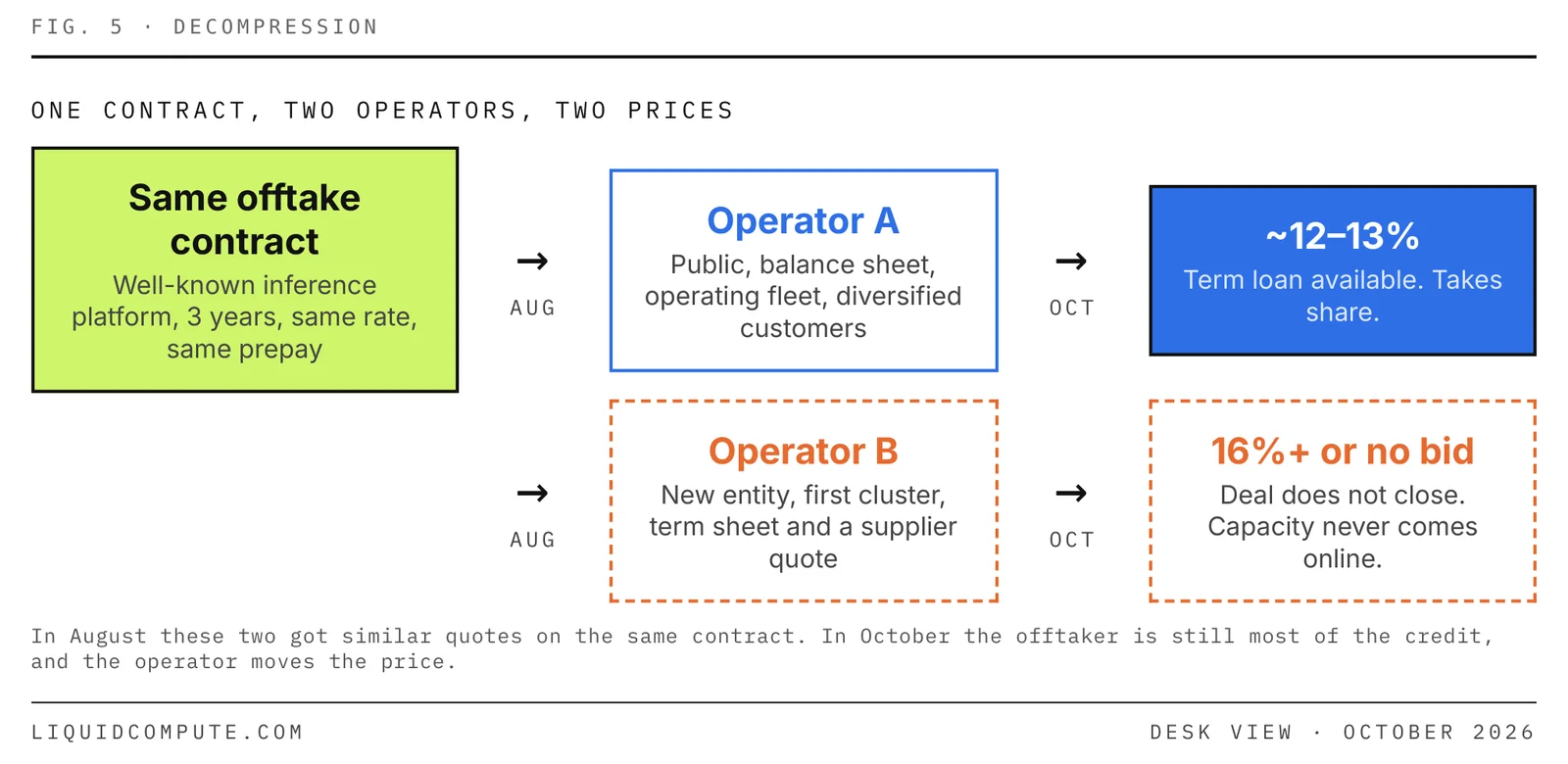
In credit we call this decompression. When money's cheap everything trades together and the gap between a BB and a CCC collapses, because the market isn't paying anyone to tell them apart. When money gets expensive the gap blows out. The BB didn't get worse. The market just started paying for the difference. The offtaker contract is still the bulk of the credit. But a take-or-pay is only take-or-pay if the operator delivers. Most of these contracts let the buyer claw back credits or walk if uptime slips, so an operator that can't run the cluster turns a three-year contract into a three-month one. The operator's ability to deliver is part of the offtaker credit, not separate from it. That's why operator capitalization and track record move the price now, in ways they didn't before.
And it isn't just the debt. A GPU loan funds 70 or 80% of a cluster and the operator brings the rest, so the equity check is what unlocks the lender in the first place. That check is harder to get too. There are a lot more neoclouds pitching the same story to the same handful of equity investors than a year ago, and those investors are doing what the lenders are doing, asking who the operator is before who the offtaker is. So the operators who can't raise the equity can't get the debt, and the ones who can get both are the ones with something to point to. The crowding was always going to resolve somewhere. It's resolving in the capital stack.
One more thing about those contracts, because it's a feature of the market rather than anyone doing anything wrong. Both sides are padding. Buyers sign a bit more capacity than they'll take, the way you pad an order in a hot new issue, because some suppliers won't close their financing. Sellers show a block to more than one buyer, because some deposits won't arrive. Rational on both sides. It also means contracted demand is gross, contracted supply is gross, and the netting happens on financing day. Worth keeping in mind the next time you see a backlog number.
Why I think this is healthy
This isn't fiber. Fiber got built for traffic that showed up a decade later. These GPUs are sold out the day they land. But demand being real doesn't exempt the financing from a cycle. Every asset that ended up essential had a year like this one. Telecom in 2000, energy high yield in 2015, LBO paper in 2022. Each time, cheap capital funded the weakest participants, the capital repriced, the weakest left, and the assets ended up with stronger owners and a credit market that worked. The asset was never the problem. The capital structure was. That's what compute is living through now, and it says nothing about whether the demand is there.
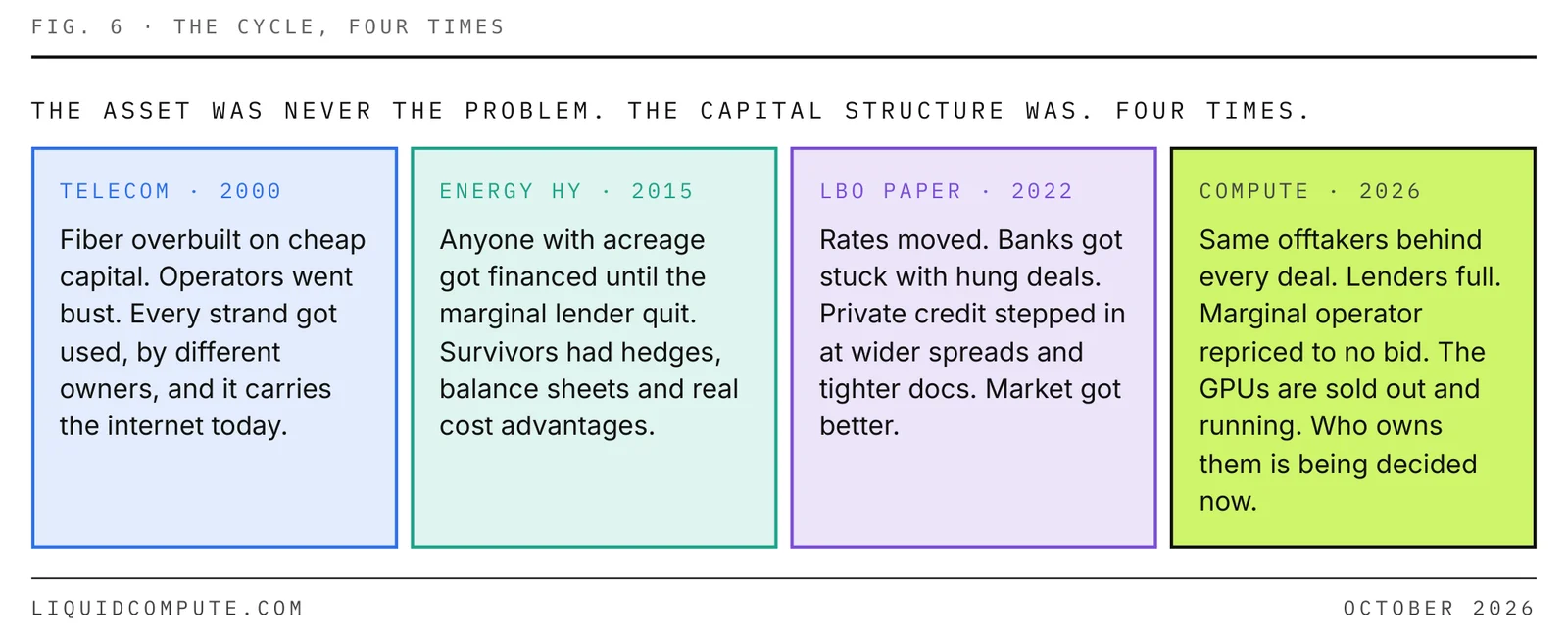
I'd rather be in compute the year after this than the year before it. The buildout doesn't stop. It just gets owned by people who can carry it.
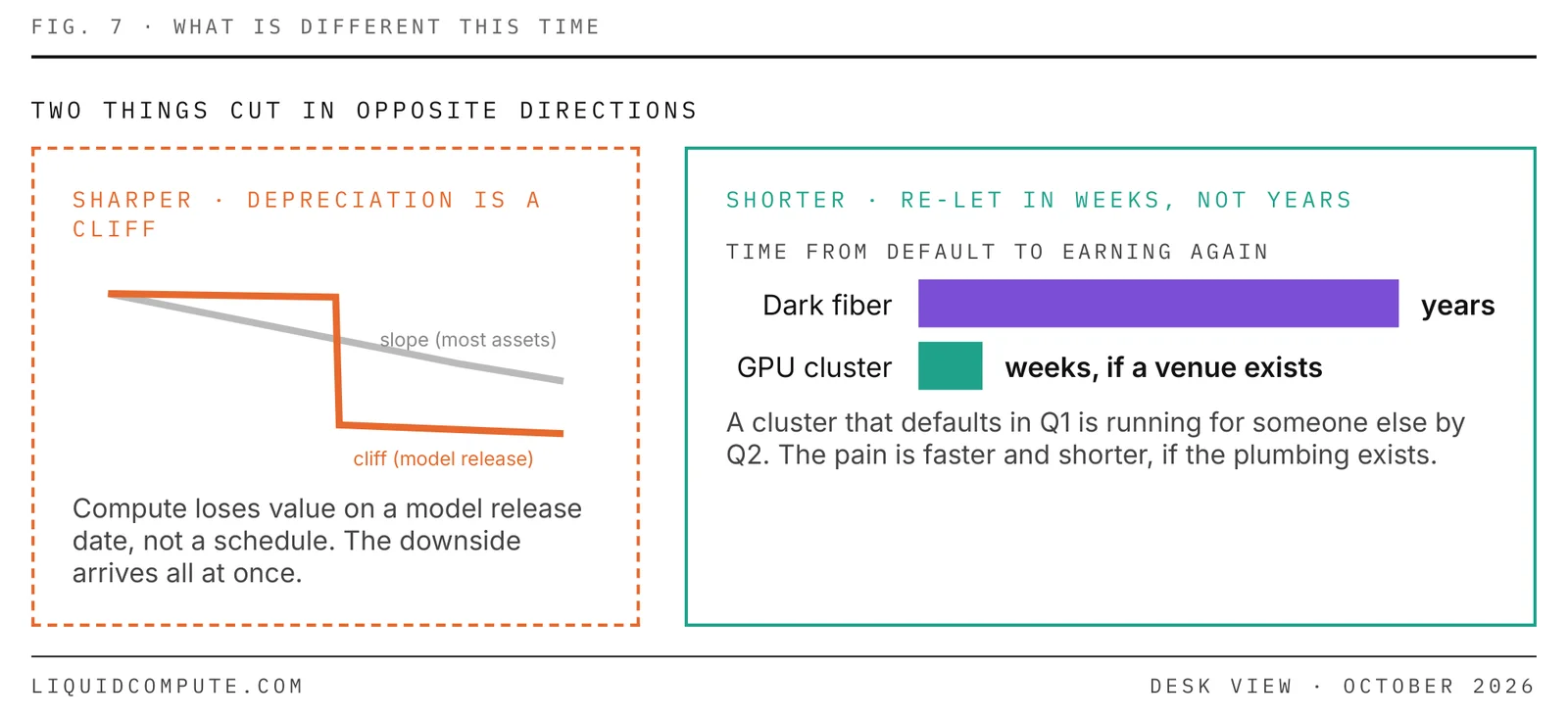
Two things are different this time, and they cut in opposite directions. Compute depreciates on a model release, not a schedule, so the downside is a cliff instead of a slope, and that makes the cycle sharper. But compute also gets re-let in weeks, not years. Fiber sat dark for a decade. A cluster that defaults in Q1 is running for someone else by Q2 if there's a venue to move it. The pain is faster and shorter, if the plumbing exists.
What I think happens next
Defaults and remarketed capacity, but not the kind people expect. An operator with a signed take-or-pay from a real buyer doesn't default because the GPUs sat idle. The buyer pays either way. The defaults come from four places.
- The deposit stage. Operators put down 20 or 30% to get in the queue and planned to borrow the balance at delivery. If that loan doesn't close, the hardware never ships and the deposit's stuck.
- The covenants. Spring loans were written with borrowing bases that reference what the hardware's worth. Nobody's re-marked them for a market that just repriced, so a loan can be current on every payment and still trip a test.
- The SLA. A first-time operator misses uptime, the buyer takes its credits or its exit, and the contracted revenue the loan was sized on isn't there anymore.
- The one that ripples. Offtakers at the lower end of the credit map, whose ability to pay a three-year contract is their next round. If venture funding tightens, some of them don't make it, and the operator's contracted revenue turns out less contracted than it looked.
Capacity gets re-let for all four reasons, and lenders who've never remarketed a cluster are about to learn what that involves. It's also where the recovery data finally comes from, which is what's been missing all along.
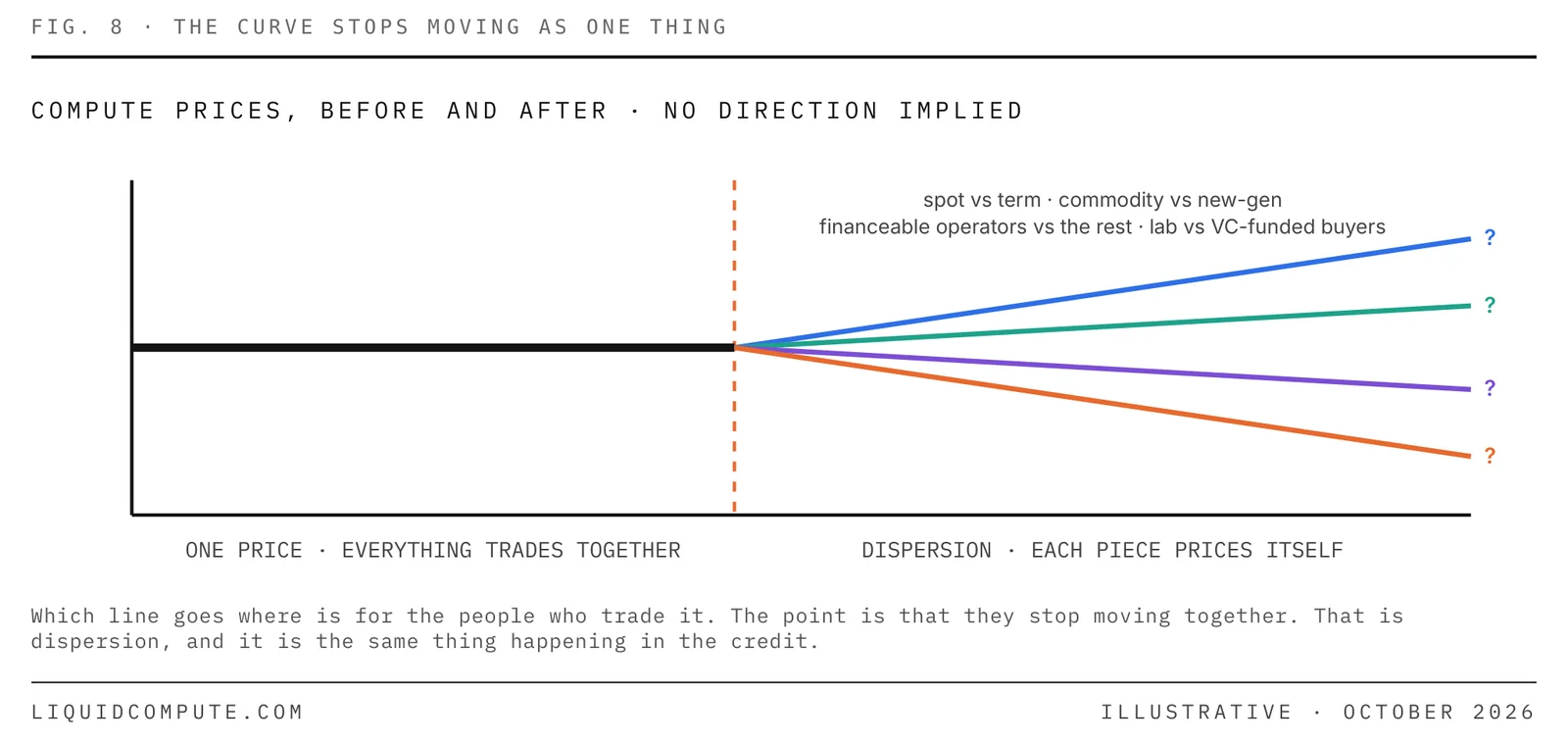
On price, I'd be careful with anyone who tells you they know. Two forces are pulling in opposite directions. Supply that can't get financed doesn't show up, and re-let capacity from defaults does, so the short end and the long end of the curve are getting different signals at once. If venture funding gets more expensive following public markets, which it has every time, most recently in 2022, the venture-funded buyer's compute budget shrinks with it. The lab funded by a hyperscaler or a sovereign doesn't notice. What I'm fairly confident of is that the curve stops moving as one thing. Spot and term, commodity and new-gen, financeable operators and the rest, all start pricing separately. That's dispersion, the same thing that's happening in the credit, and it's why I'm as excited about this moment as I am. A market where everything moves together is one that hasn't had to tell its participants apart yet. A market where things price separately is one that's grown up. Compute is crossing that line right now. We run an index, so I'll leave the direction to the people who trade it.
Residual value becomes a real question, and then a real market. For two years nobody had to ask what the hardware's worth at the end of the contract, because the offtaker carried the loan. Now lenders are asking, operators with long-dated capacity want to lock in what they can, and for the first time there's natural interest on both sides. That's what a hedging market needs to start, two sides who each want the other's risk, and it's showing up because of the crunch, not in spite of it.
What I'd do, depending on where you sit
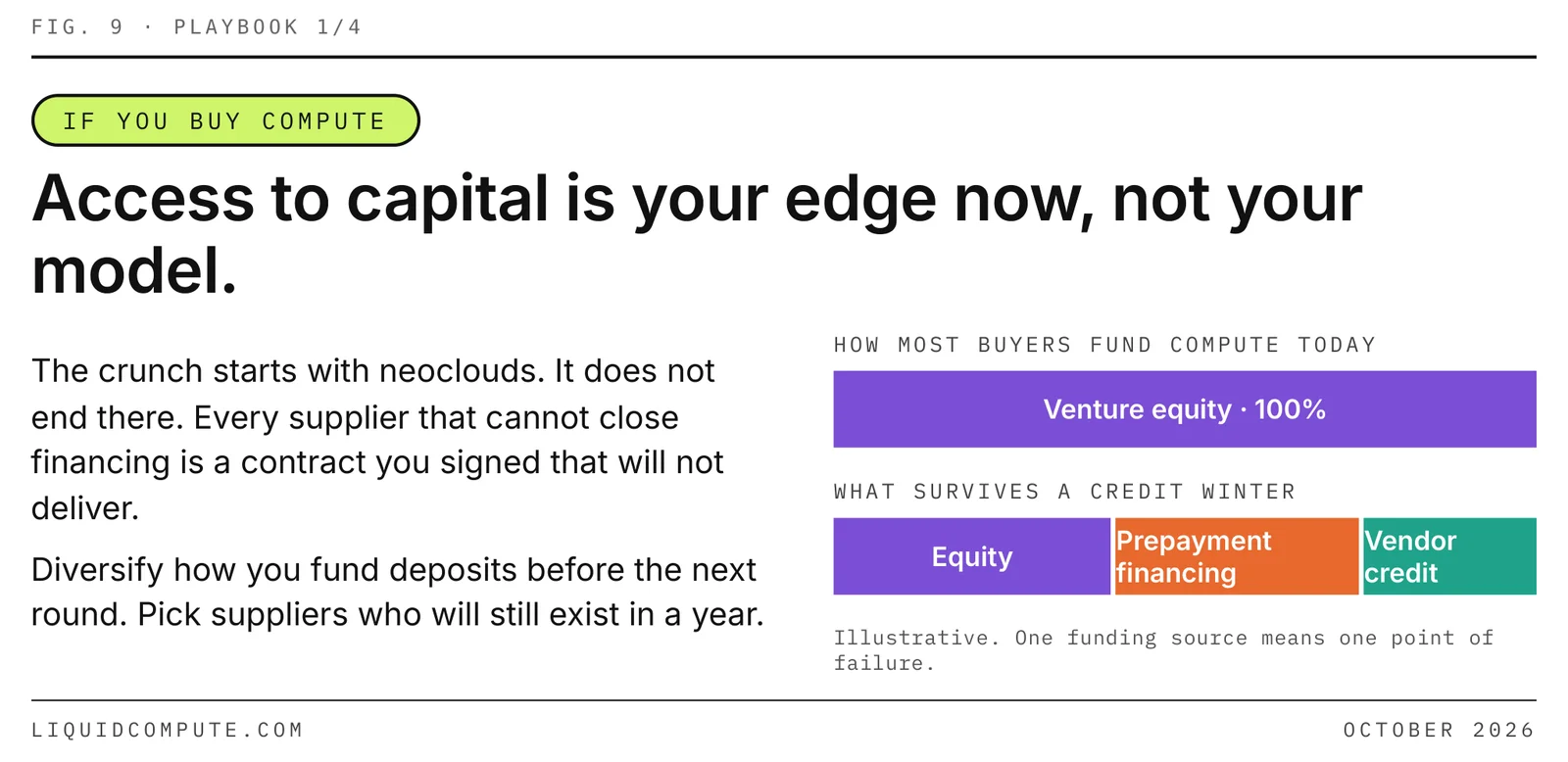
If you buy compute. Capital structure is a competitive advantage now, and almost nobody's treating it like one. The buyers who get capacity next year are the ones who can fund it more than one way. Treat how you pay for compute the way you treat where you buy it from, as something to diversify on purpose, and sign contracts a lender can take assignment of, because that's what makes your contract financeable if you ever need it to be.
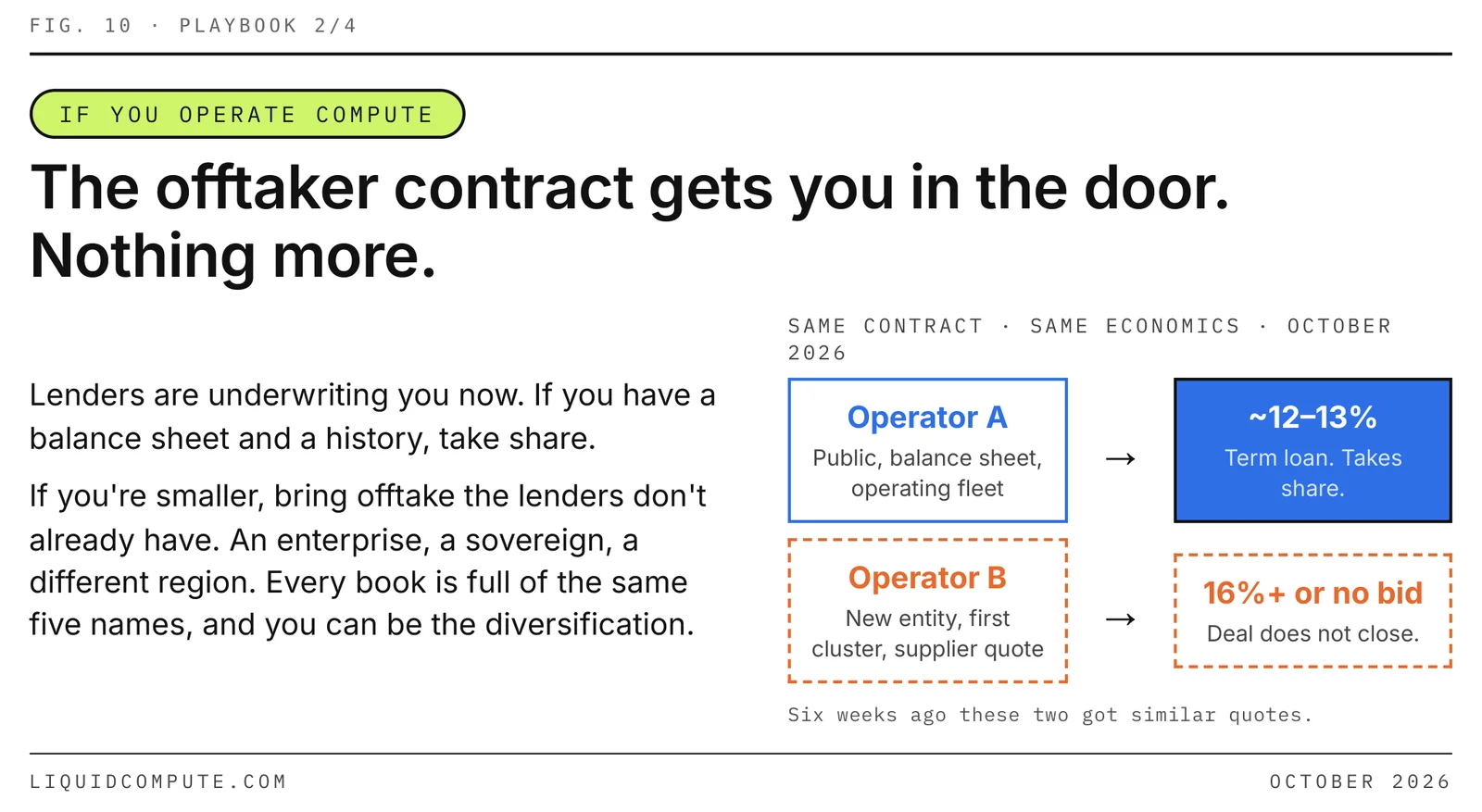
If you operate compute. The offtaker contract gets you in the door and that's it. Lenders are underwriting you now. If you've got a balance sheet and a track record, take share. If you're smaller, the fastest way to look different from the hundred other neoclouds pitching the same lender is who's on the other side of your contracts. Every lender's book is full of the same five inference names. Show up with an enterprise, a sovereign, a university, a buyer in a different region, and you're the diversification they can't get anywhere else. That's worth more to a lender right now than another point of coverage. And if you've got a term sheet and a dream, close what you can now and stop assuming the next deal prices like the last one.
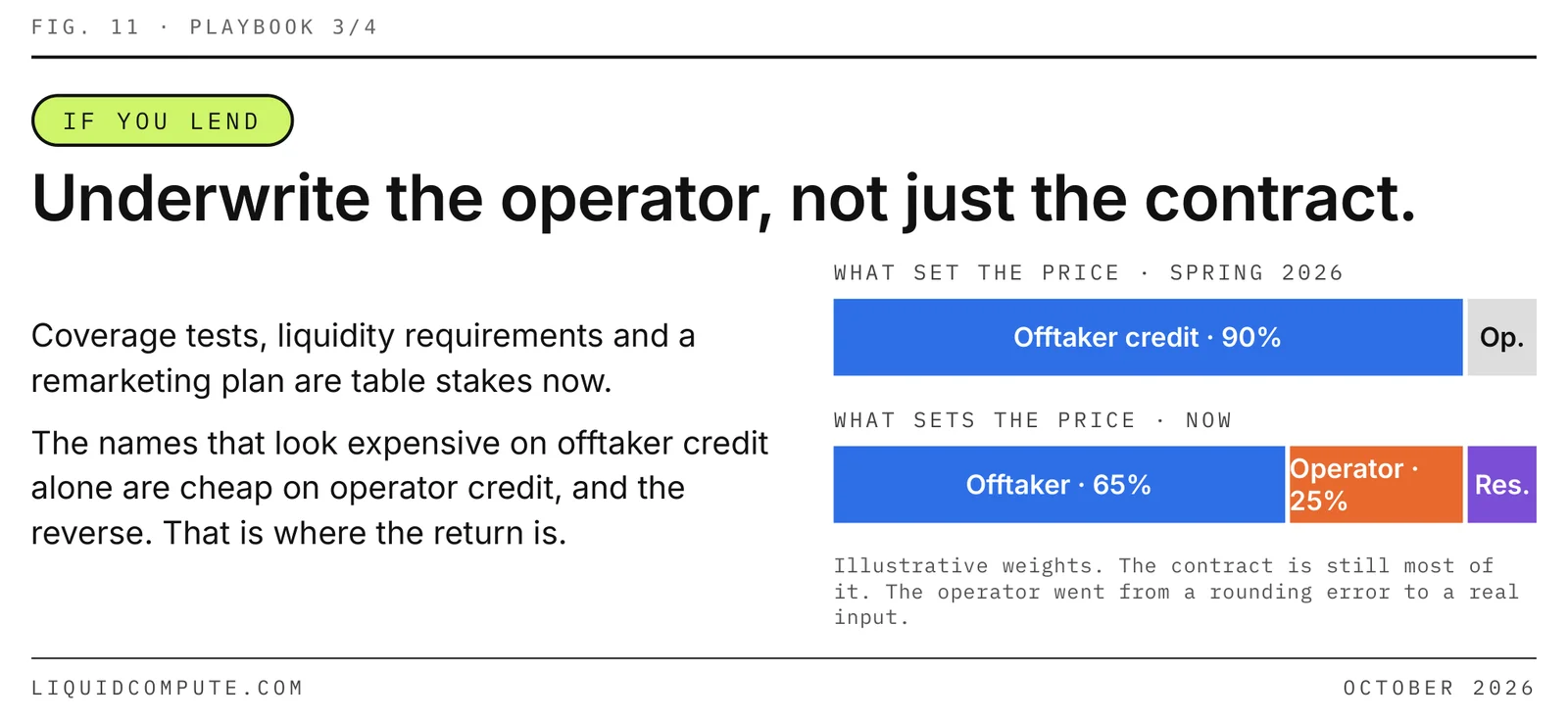
If you lend. Underwrite the operator, not just the contract. And get a mark on the hardware, because some of the loans you're passing on today are cheap on operator credit and you can't tell which until you can price the bottom. That's why we publish a reference price for compute. It's what these contracts are written against, and it's what a residual mark gets built from.
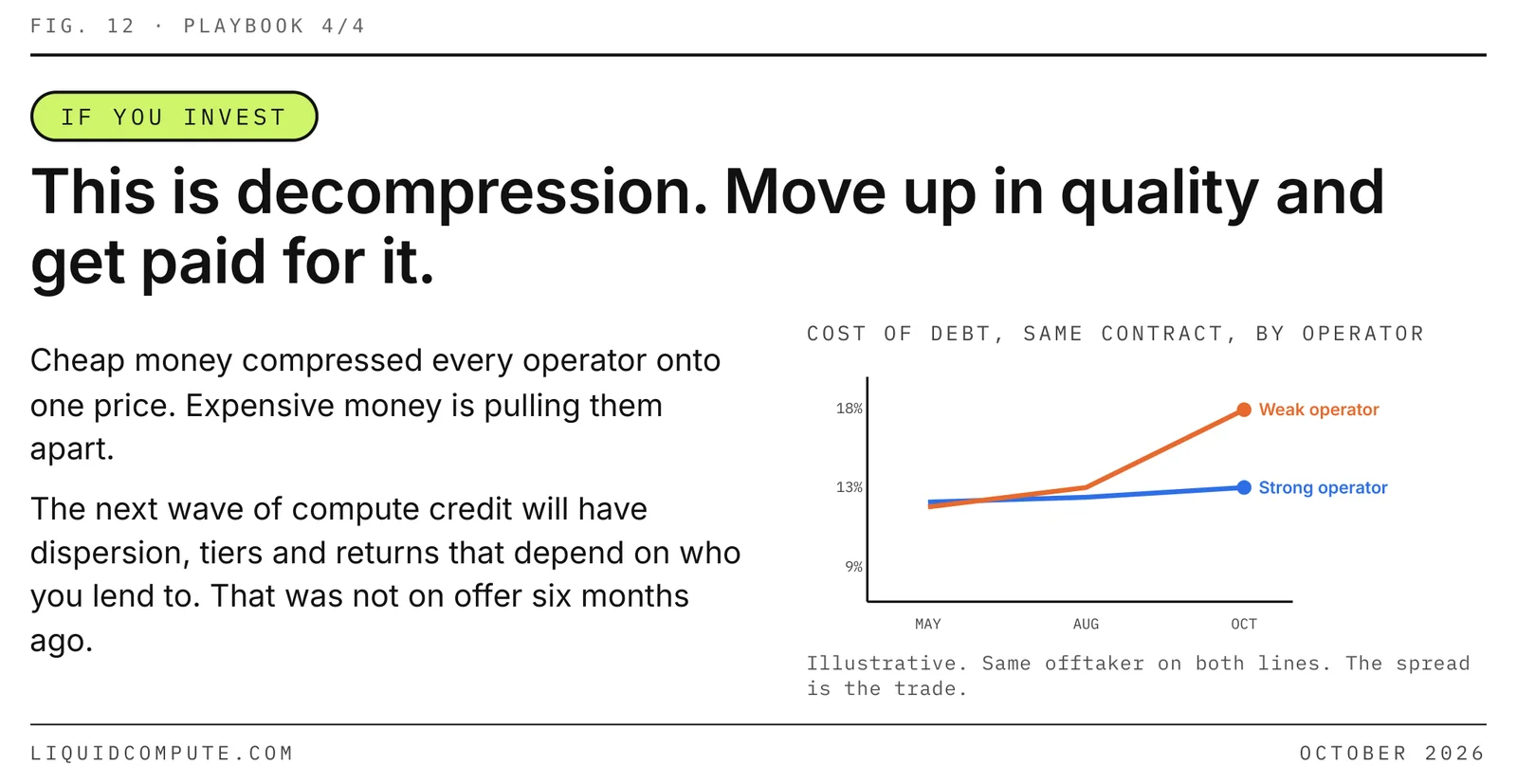
If you invest. You know this one. Decompression, move up in quality, get paid for it. The next wave of compute credit is going to look like an actual credit market, and you couldn't get that six months ago.
None of this is a reason to be scared of compute. It's a reason to be careful about who you do it with, and to want a market where the hardware can be marked and moved. The market just started paying for that judgment, and in my experience it keeps paying for a long time.
That's what we're building at Liquid Compute. A venue to buy, sell, finance and hedge compute, with a reference index underneath it, so that when a cluster needs a new home it has somewhere to go. If you're on any side of what I just described, we want to hear from you.
© 2026 Liquid Compute · This is not investment advice · Liquid Compute does not take positions on its own index