Tier 2: Trading firms, revenue-stage AI apps, and the structure that gets them financed
The GPU Offtaker Credit Map · Part 2 of 5. Series: One tier at a time.
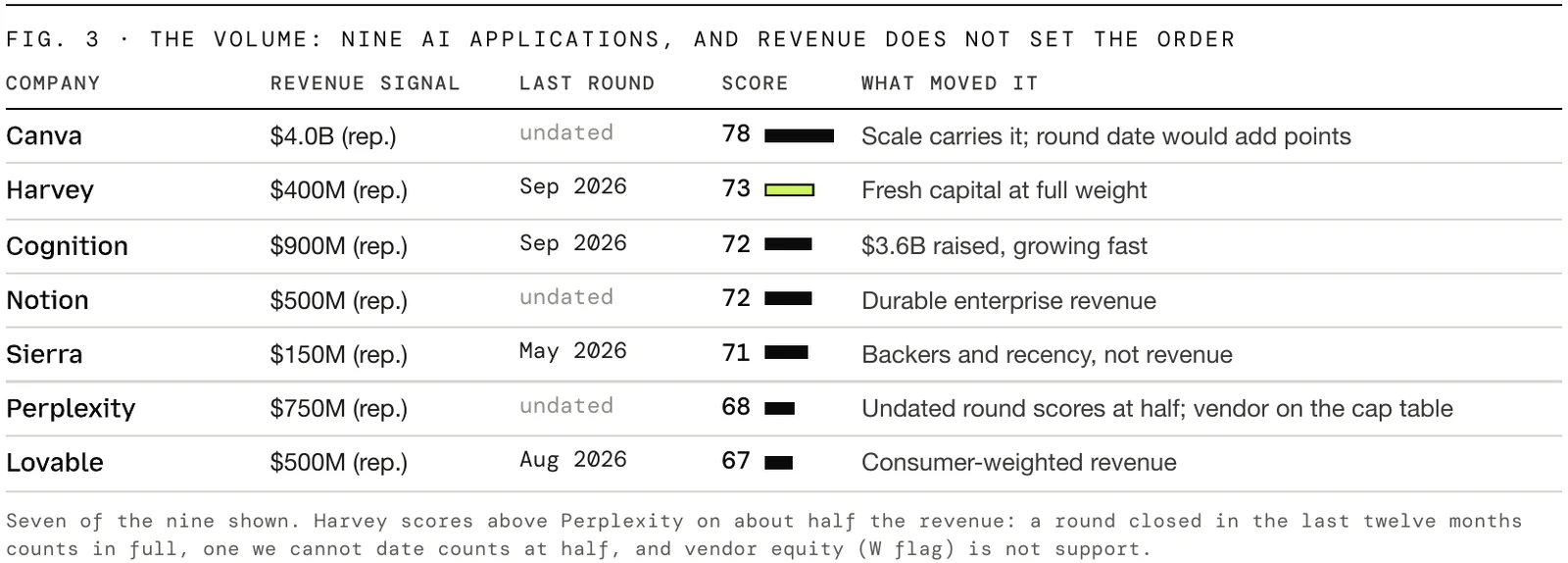
We are moving the series forward by taking a look at the next tier of companies in the Offtaker Credit Map. Tier 2 is thirty companies that are able to finance compute purchases with modest support. In this case that means three to six months of prepayment, or a small reserve. Nine of them are AI applications whose disclosed revenues range from $150M to $4B. Interestingly, seven are trading and investment firms. I remember being surprised, when I looked at investing in the latest CoreWeave DDTL, that Jane Street was alongside Anthropic as one of the named offtakers. The more I thought about how to price that risk, the more it made sense. The rest are media companies, compute intermediaries, robotics and one games company.
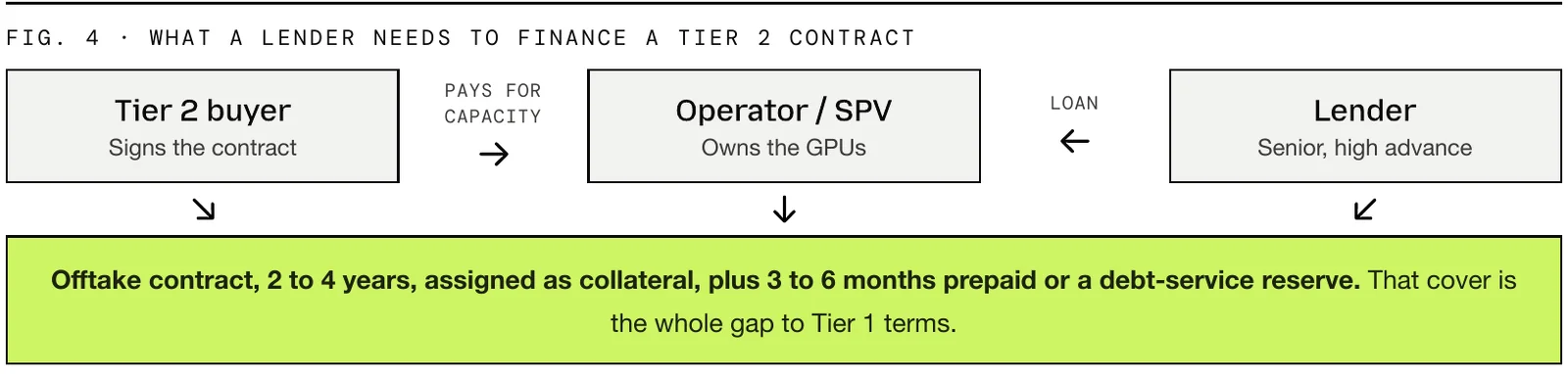
What the tiers measure. Any buyer can sign a multi-year contract with a few months of prepayment, and many Tier 3 buyers do. The tier describes what a lender needs before it will advance against that contract at a good rate. A Tier 2 contract gets financed on light support. The same contract from a Tier 3 buyer gets a lower advance, a shorter tenor or a request for more cover, and that cost comes back to the buyer.
Why this tier matters. The biggest names here already get Tier 1-style paper. The rest mostly does not, yet. An app with $500M of revenue is still financed like a startup. Put Tier 3 structure on these contracts and another lender takes the operator's business; lend like Tier 1 and you are under-protected. This part is about where the line sits.

The surprise: the trading firms
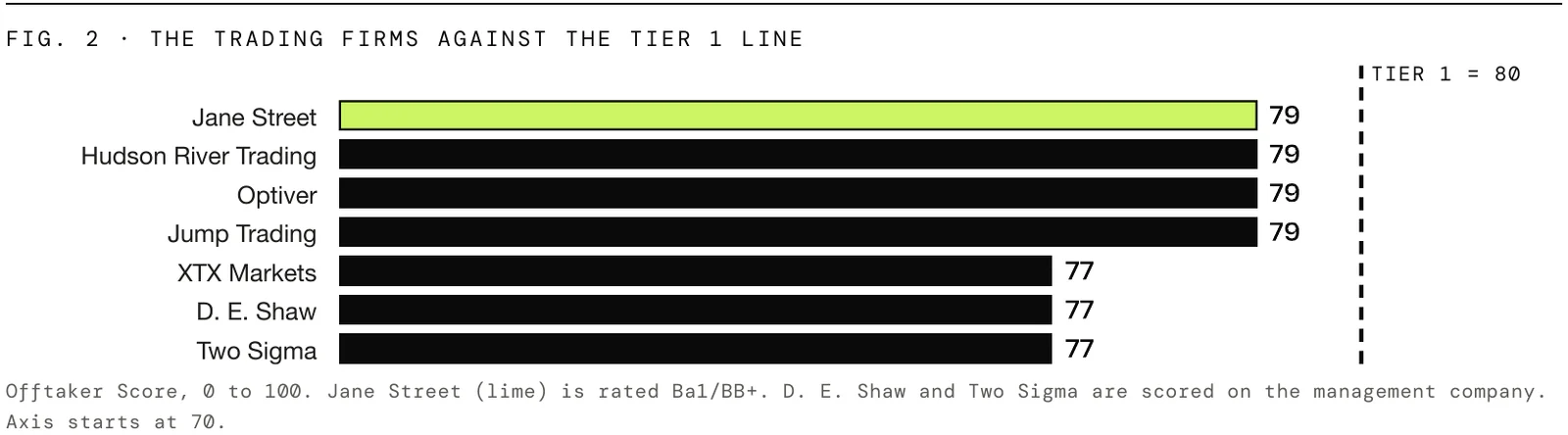
Seven partner- or founder-owned firms raise no outside equity and most publish no revenue. We score them as one peer group: funding on self-funding, revenue on a sourced figure where one exists and otherwise on capitalization, and track record by years of operation. They land at 77 to 79. Tier 1 starts at 80.
Why Tier 2 is a compliment

Jane Street is the cleanest case. Fitch rates it BBB- (upgraded in July 2026), Moody's Ba1 and S&P BB, the last two with positive outlooks. Our rule takes the middle rating, and Ba1/BB+ is Tier 2: a crossover credit on its way up. The model lands it in the same tier on its own inputs. Its Crusoe contract and HRT's CoreWeave deal show what financing against one of these contracts looks like when the lender underwrites the firm rather than the sector: multi-year paper, light structure, with the largest operators in the market.
D. E. Shaw and Two Sigma sit just below on purpose: they are investment managers, so we score the management company, a fee stream from funds that can redeem.
The highest score in the tier outside the trading firms is Together AI at 78, tied with Canva, on $1.1B of bookings and a round closed in July. It is the clearest case that an inference platform can carry a multi-year contract on light support.
On a revenue-led weighting all seven cross into Tier 1, which is why ratings, not our weights, decide where the rated firms sit. These are strong credits with thin public disclosure. A lender who sees their numbers under NDA will price them better than the public tier suggests.
For lenders
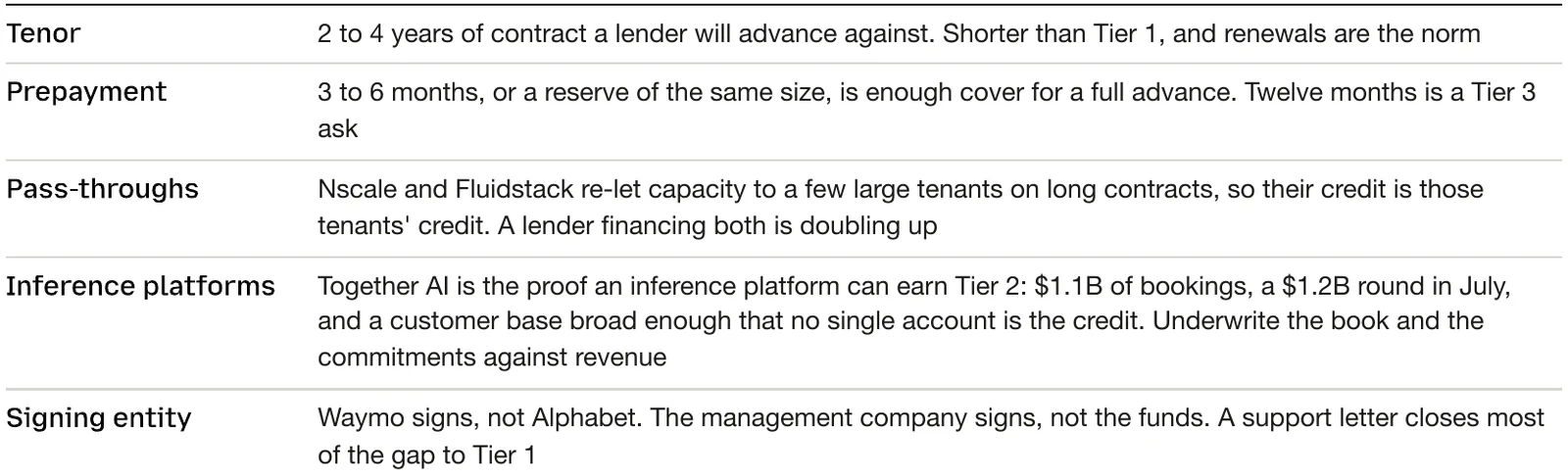
Advance against these contracts one notch below Tier 1, not three. Three to six months of cover is enough. If you insist on twelve, the operator will find someone who asked for three, and that lender keeps the relationship.
Size the rated firms off the rating. Jane Street is Ba1/BB+ with positive outlooks, and that is the credit, not the sector.
Look through the pass-throughs. Nscale and Fluidstack's credit is their tenants' credit. If you already lend to those tenants, you are not diversified. Together AI is the other kind of reseller: a broad book on usage pricing, which at $1.1B of bookings is a credit in its own right.
Check who signs. D. E. Shaw and Two Sigma sign at the management company, Waymo without Alphabet. Get the support in writing or price as if it isn't there.
Vendor equity is not a guarantee. Eleven of the thirty carry a W flag, meaning NVIDIA or a hyperscaler is on the cap table. It helps them raise money. It does not mean anyone steps in on a missed payment.
For companies
Your contract is good collateral. An operator can borrow against it on light support, so do not accept a twelve-month deposit when three to six is what its lender actually needs.
Trading firms: your credit is worth money. Jane Street and HRT have shown the terms are there, and most operators still pitch the labs first. You lower the operator's cost of capital, so ask for a piece of it.
Apps: close the round first. A round in the last twelve months counts in full, an older one at half, so close it, then negotiate the compute contract.
Resellers: show the book. Tenant contracts if you have a few big ones, retention and revenue history if you have thousands of small ones. Either way the structure gets lighter.
Most of Tier 2 is a visibility gap. A revenue range under NDA can close it.

Part 3 · Tier 3
Where most buyers sit: prepay financing, letters of credit and shorter tenors doing the work
Part 4 · Tiers 4 and 5
Structure is the product: escrowed capacity, step-in rights, remarketing and price protection
Part 5 · Lenders
What lenders told us, and what changes in the next edition
Public information only. Not a credit rating, investment advice or an offer to lend. Tiers describe the structure a lender would typically need, not the quality of a business. Liquid Compute has commercial relationships with some companies in the Credit Map; they did not affect scoring.