The Tenor Trade
How compute gets bought long and sold short, what it pays, and where it breaks
If you have been offered a three-year block of GPUs at a price that looks cheap next to what the same capacity rents for by the month, you have been shown this trade. Most people looking at it know it exists. Fewer know what they are actually being asked to underwrite.
The trade in one sentence
You buy capacity for a long term at a low fixed price and sell it in short pieces at a higher floating price, and you keep the difference if you can stay filled.
That is it. It is what a landlord does when they sign a ten-year lease and sublet by the month, or what a utility does when it buys power on a long contract and sells it to customers at variable rates. Compute has a term structure and this is how it is being traded.
Why the curve looks like this
As we have written before, the same GPU rents at very different prices depending on how long you commit.
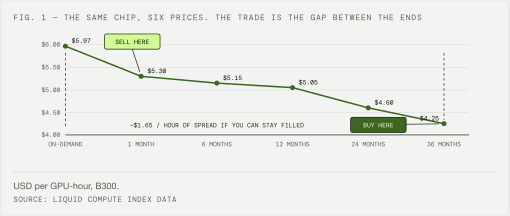
Right now B300 on-demand prints around $5.97 an hour on our index. Month-to-month capacity has recently been clearing around $5.30 for operators we work with. Twelve-month reserved blocks clear in the low fives. Three-year contracted capacity clears around $4.15 to $4.30. Every six months of additional commitment is worth roughly 35 to 60 cents of price.
That gap is not a mistake and it is not free money. It exists because the operator who sells you three years at $4.25 is getting three things they cannot get from a month-to-month customer: contracted revenue they can borrow against, a prepayment that funds their hardware purchase, and freedom from having to find a new buyer every thirty days. They are paying you, in the form of a lower price, to take those problems off their hands.
When you do the tenor trade, those problems become yours. So does the opportunity.
A worked example
Eight nodes of B300, 64 GPUs. You buy three years at $4.25 with 30 percent prepay. That is $2.38M a year of fixed cost, $7.15M over the term, and $2.14M of cash out the door at signing.
You then sell the capacity month to month, thirty-six times over the life of the contract. The path below is illustrative only. It is one of many ways the next three years could go, drawn to show the shape of the problem rather than a forecast.
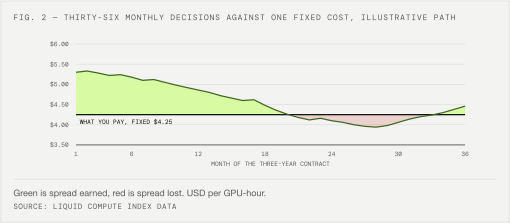
Two numbers drive everything, and only one of them is fixed.
$4.25 is your cost. It is in the contract. It does not move for three years.
$5.30 is where you start, not where you end. It is roughly what month-to-month B300 clears today. Over the contract your real re-let price is the average of thirty-six separate decisions, each made at whatever the market is on that day, and nobody knows that number in advance.
So the right way to look at the trade is as a grid, not a point.
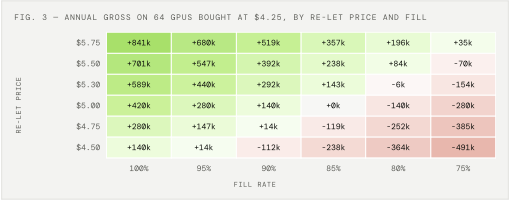
At today's prices and full utilization the trade pays about a dollar an hour, roughly $590k a year on $2.14M of capital. That is a very good return. At 90 percent fill it is half that. At 80 percent fill and $5.00, it is nothing.
And the two axes are correlated. They move together in the wrong direction, because the months when capacity is hardest to fill are the months when prices are falling.
The number to know is breakeven fill. Divide what you pay by what you can re-let at. That is the share of hours you must keep sold just to cover the contract.
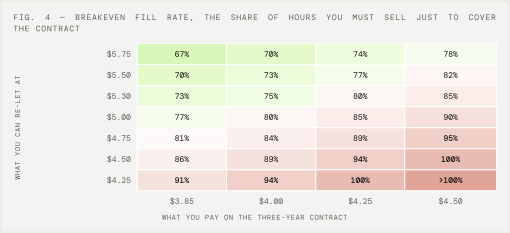
At $4.25 cost against $5.30 re-let, you need 80 percent of your hours sold. If re-let drifts to $5.00, you need 85 percent. At $4.50, you need 94 percent. If the market ever reaches your cost, you need every hour sold to break even, and you will not get every hour sold.
What you are actually underwriting
Three risks, and they are not the same.
Re-let risk. Every month you have to find a buyer. That is a distribution problem, not a trading one. If the market is oversupplied when you need to place capacity, you carry idle hours at full cost. This is the risk most people underestimate, because it is operational rather than financial and it shows up slowly. It is also the one we solve directly. Liquid Compute places capacity for operators every week, and a block bought through us comes with the sales function attached.
Price risk. You are long compute. If B300 rental rates fall from $5.30 to $4.50 over the next eighteen months, your margin goes from a dollar to a quarter, and at 90 percent fill you are losing money. You have no protection against this in the physical contract, because you agreed a fixed cost and the market sets your revenue.
Spec risk. A three-year contract on a B300 is a claim on a specific chip. If the frontier moves up in what it needs, the capacity becomes hard to sell before the contract legally ends. That is not a slow decline you can model. Obsolescence in this market is a jump on a model release date, and a three-year contract can become an eighteen-month contract overnight. Nobody knows when.
Of the three, price risk is the one you can do something about.
Hedging the back half, even partially
You cannot hedge re-let risk and you cannot hedge spec risk. But you can hedge the price, and you should hedge some of it.
The mechanism is a cash-settled forward. You sell forward a portion of your capacity at today's forward price. Nothing about your physical business changes. You still sell month to month, whether through your own team or through us, and you still run the operation. The forward settles in cash against a published index at the end of the period.
If the market falls, your monthly revenue drops and the forward pays you the difference. If the market rises, you earn more on the physical and pay it on the forward. On the hedged portion, your price is fixed. On the rest, you keep the view.
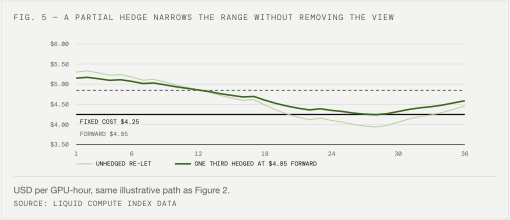
What to hedge. Not all of it. The point of the tenor trade is that you believe short-term prices will stay above your long-term cost. A full hedge removes that view and leaves you with a lower-margin, no-upside version of the trade. Instead, hedge enough that a bad year does not put you underwater. A third to a half of the book is typical. That covers the downside you cannot afford, and leaves the rest on the view you did the trade for.
When to hedge. Current liquidity sits in the one-to-two-year part of the curve, which is where market makers are quoting today. So hedge the first one to two years at signing, and roll the back end as it comes into range. That covers the period where you have the least information and leaves the later years open, which is where you actually want the view.
What it does to your financing. This is the part most people miss. Uncontracted capacity is worth almost nothing to a lender, because it is a forecast about future sales rather than revenue. Sold forward, it becomes contracted revenue. That changes your advance rate. In many cases the improvement in financing terms is worth more than the upside you gave up.
What it takes to run
Capital. The prepayment is real cash. On the example above that is $2.14M at signing before you have sold an hour. It comes back over the contract, but it goes out first.
Distribution. Someone has to place the capacity every month. That takes a sales function, and if you do not have one, we do. Placing capacity for operators is what our brokerage does every week, and a block bought through us comes with it.
Hosting. The capacity has to sit somewhere. Either the seller hosts it, in which case that is in your cost, or you do, in which case it is a second contract.
Paper. The long-dated contract needs to be assignable, so you can exit if you need to. The short-dated ones need to be standard enough to sign quickly. And the hedge needs an ISDA. We can help set all three up, and our order forms already carry the assignment language.
Where we come in
We see both ends of this curve. Three-year blocks from operators who want to sell term, and short-dated demand from buyers who want flexibility. That is how the trade gets found.
We place capacity for operators, so the re-let risk that stops most people from doing this is the thing we do every week.
We publish the index the hedge settles against, and we price the forward. So the capacity you buy long and the risk you hedge reference the same number.
And when the year goes by and you need to place the next twelve months, you can do that here too.
If you have been offered a block and want to know whether it pencils, send us the terms. We will run it and tell you where breakeven sits.
Liquid Compute
stanley@liquidcompute.com