The GPU Offtaker Credit Map: 200 Private AI Compute Buyers, Ranked
A shared way to think about offtaker credit.
Why we built this
A shared way to think about offtaker credit.
Private AI companies now sign multi-billion-dollar, multi-year GPU contracts, and almost none of them has a credit rating. There is no agreed way to judge whether a lab, an inference platform or a neocloud can keep paying for the full term, and the developers, lenders and GPU owners who carry that risk each price it their own way.
This report is our first attempt to change that. We built a transparent framework, the Liquid Compute Offtaker Score, and used it to assess 200 private buyers of compute from public information. It is not a rating. It is a starting point: a shared way to think about offtaker credit, with every weight and input published so readers can test it, re-weight it and tell us where it is wrong.
We want it to start a conversation. Lenders, developers and the companies themselves each see parts of the picture we cannot, and the framework will get better as they share what they see. We will update it each edition, and re-score any company that shares data with us under NDA.
Executive summary
38 of 169 scored companies can support a multi-year offtake today.
We scored 169 private companies that could sign multi-year GPU capacity contracts, and 38 of them can support one today with light or modest credit enhancement. Another 31 are listed without a score because there is not enough public data to rate them. The rest can still be excellent customers, but they need structure: prepayment, shorter tenors, reserves or sponsor support.
A low score says what structure a lender will need, not how good the business is. Most companies in the lower tiers are well run and well backed. They are earlier in their life, or less visible, than an unsecured multi-year obligation requires.
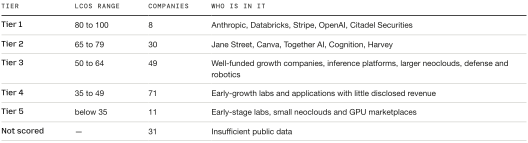

Three findings stand out. First, the strongest private offtakers include trading firms and profitable private corporates, not just AI labs; Jane Street’s reported $13B, five-year Crusoe contract is the clearest example. Second, headline valuations are a poor guide to credit: what decides an offtake is how much compute a buyer has committed against the capital it has raised, and several well-known labs have committed more than they have ever raised. Third, the market is consolidating fast, so change-of-control protection belongs in every offtake.
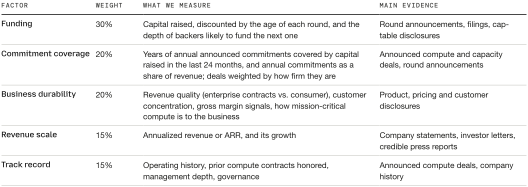
The Liquid Compute Offtaker Score (LCOS) combines funding (30%), commitment coverage (20%), business durability (20%), revenue scale (15%) and track record (15%). The methodology section defines every input, including how funding is discounted by age, so readers can re-weight to their own view.
Why offtaker credit matters
The contract is the collateral that matters most.
In GPU project finance, the offtaker’s credit is the collateral that matters most. A GPU cluster is a fast-depreciating asset; the contract that pays for it is what lenders actually underwrite.
An offtake is a long-term commitment by a buyer to rent a defined block of GPU or cluster capacity, usually 2 to 5 years, signed before the hardware is bought or the facility is financed. The data center or cloud provider uses that contract to raise debt. If the offtaker is strong, the debt is cheap and the loan-to-value is high. If the offtaker is weak, the provider needs prepayments, reserves, guarantees or equity to fill the gap.
The buyers have changed. Five years ago, the answer to “who is the offtaker?” was usually a hyperscaler. Today a large and growing share of demand comes from private companies: AI labs, inference platforms like Modal, coding and agent companies, video and voice model builders, robotics and science labs, and the neoclouds that resell capacity to all of them. Most of them do not publish audited accounts and none carry a public credit rating.
That is the gap this report tries to close. We assessed 200 private potential offtakers and ranked the 169 with enough public data on a single, transparent credit framework, so that developers, lenders and GPU owners can compare counterparties on the same basis.
Methodology
Five weighted factors, every input published.
Each company gets a Liquid Compute Offtaker Score (LCOS) from 0 to 100, built from five weighted factors. The score is a relative ranking from public information, not a credit rating.
Who is in the universe
A company qualifies if it is privately held (or a separately capitalized private subsidiary), consumes GPU compute at meaningful scale today or has the capital to do so, and could plausibly sign a multi-year capacity contract with a Western data center or cloud provider. We excluded publicly listed companies, companies acquired outright, and companies headquartered in China, where export controls make a US or European offtake impractical.

How each factor is scored
Revenue scale is scored on a log scale, because the difference between $10M and $100M of ARR matters as much as the difference between $1B and $10B. Roughly: $10B+ scores 100, $1B scores 80, $100M scores 60, $10M scores 40, pre-revenue scores 10 to 20.
Every revenue figure also carries an evidence-quality haircut. Company-confirmed or investor-disclosed figures count in full. Figures from credible reporting (for example The Information, Bloomberg, Reuters, FT) count at 85%. Third-party estimates count at 60%. No figure means the factor is scored on capitalization alone.
Funding measures capital raised, not capital available, because we cannot see how much has been spent. The date of the last round is the best public proxy for whether the money is still there, so each round counts by its age at the report date: in full if it closed within 12 months, at 50% if it is 12 to 24 months old, and at 25% if older. Where we could not source a round date, capital counts at 50%. The last round is the most recent primary financing, equity or committed debt; employee tenders and secondary sales do not count. Its date is shown in every table, so readers can apply their own view. Self-funded, profitable firms and sovereign-backed platforms are scored on their own resources rather than on rounds.
Backer depth makes up 40% of the funding factor and asks one question: if this company hits a bad quarter, who writes the next check? A cap table with NVIDIA, a hyperscaler, a sovereign fund or several top-decile venture funds scores highest. A single-fund or angel-led cap table scores lowest. Capital and backers form one factor rather than two because they move together; scoring them separately would double-count funding and make the score track valuation.
Commitment coverage asks whether a buyer can keep paying for the whole term of a contract. We annualize each announced third-party compute deal over its stated term, or over five years where no term is disclosed, and weight it by how firm it is: firm contracts count in full, phased or “up to” contracts at 60%, and frameworks, letters of intent or contracts cancellable at short notice at 25%. Deals we cannot classify from the cited sources are marked unclassified and count as firm, which is the conservative treatment for a lender.
We then measure two things: how many years of those annual commitments the capital raised in the last 24 months would cover, and annual commitments as a share of revenue where a revenue figure exists. Two years of coverage, or commitments at half of revenue, scores 65; each doubling of coverage adds 25 points, and each doubling of the revenue share takes 20 away.
Where no commitment has been announced, the factor scores a neutral 65 rather than dropping out, so a company is neither rewarded for signing quietly nor penalized for disclosing. An announced deal is also evidence of scale, which is why we score it on coverage rather than simply counting it against the buyer. Capital raised in the last 24 months uses the most recent round only, so coverage is a lower bound. None of this measures cash, which no public source shows; a company that shares its real liquidity with us under NDA can move up a tier.
Self-funded trading and investment firms. Eight partner- or founder-owned firms (Citadel Securities, Jane Street, Hudson River Trading, Optiver, XTX Markets, D. E. Shaw, Two Sigma and Jump Trading) raise no outside equity, and most publish no revenue. We score them as one peer group on the same inputs: funding on self-funding, revenue on a sourced figure where one exists and otherwise on capitalization, one durability score for the six trading firms, and track record by years of operation. D. E. Shaw and Two Sigma are investment managers, so we score the management company, whose credit is a fee stream from funds that can redeem, with a lower durability score, and place them below Jane Street. Their regulatory assets under management, from SEC Form ADV filings, are shown as evidence of scale only: the figure is the funds’ money, gross of leverage, and does not enter the score. For both, the entity that would sign an offtake is to be confirmed.
Tier cut-offs
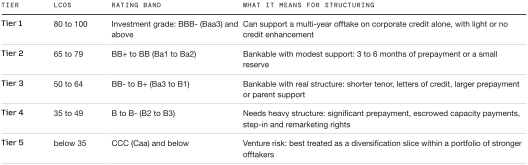
Scores are as of the report date and reflect data we could verify from public sources. A company with little public disclosure is not necessarily a weak credit; it is a less visible one, and the score says so.
Agency ratings override the model. Where a company has public agency ratings, its tier comes from the ratings, not the LCOS: with three ratings we use the middle one, with two the lower. Two companies have ratings we could confirm from agency publications for this edition. Hudson River Trading and Jump Trading also carry rated term loans; their levels were not confirmed in time, and their model tier is consistent with high-yield ratings. They will be added in the next edition. Citadel Securities is rated BBB- by S&P and Baa3 by Moody’s, which puts it in Tier 1. Jane Street is rated BBB- by Fitch (upgraded in July 2026), Ba1 by Moody’s and BB by S&P, the last two with positive outlooks; the middle rating, Ba1/BB+, puts it in Tier 2. Both land in the same tier on the model alone, a first check that the cut-offs sit in the right place. For unrated companies, the rating bands define what each tier means: a Tier 1 score is our view that a company’s public profile looks like an investment-grade credit, not a rating.
Contract size. The structuring view assumes a contract that is small next to the buyer. Where a contract’s value exceeds a quarter of the capital the buyer raised in the last 24 months, or half of its annual revenue, lenders should apply the structuring of the next tier down.
Flags used in the tier tables
- R
- Tier set by public agency ratings.
- E
- The entity that would sign is not the balance sheet we scored (see Structure flags).
- P
- Pass-through: the company resells capacity, so its offtake credit depends on its own customers, and a lender financing both it and its tenants is doubling up.
- W
- Wrong-way risk: a key backer also sells the company chips or cloud capacity, so that equity is correlated exposure, not support in a downturn.
Not yet scored: re-leasing risk. Credit risk is the chance of default and the loss if it happens, and the LCOS measures only the first. For an offtake, the loss depends on whether the capacity can be re-leased: its GPU generation, its region and whether the contract is assignable. A Tier 3 buyer on current-generation chips in a liquid US market is a different risk from a Tier 3 buyer on older silicon in a thin one. We plan to add re-leasing risk as a second rating beside the LCOS in the next edition.
Three things to keep in mind when reading the tables. The score uses public information only, so a company’s real credit may be stronger than its public profile. It measures the likelihood of default, not the loss if one happens; re-leasing risk is not yet scored. And a tier is structuring guidance, not a credit rating. The limitations section at the end sets out each of these in full.
Tier 1
Corporate-credit offtakers.
Eight companies can back a multi-year offtake on their own balance sheet. Four of them are not AI startups: a trading firm, two fintechs and a data company that have been profitable for years and now buy GPU capacity at scale. The other four are two frontier labs, a data platform and a defense company.
Citadel Securities anchors the tier. It is the one company in the report with an investment-grade agency rating, BBB-from S&P and Baa3 from Moody’s, and the model places it in Tier 1 on its own inputs too. The other trading firms sit in Tier 2, where their ratings and the model agree.
Two frontier labs reach Tier 1 on scale. Anthropic reports roughly $65B of annualized revenue and raised $65B at a $965B valuation in May 2026. Its announced third-party compute deals, about $85B with Microsoft, Nscale and Volta, run to roughly $15B a year, and its latest round alone covers more than four years of them. OpenAI makes Tier 1 on revenue and funding, not on commitments: weighted by firmness, its announced deals with Oracle, AWS and CoreWeave run to about $68B a year against $40B of run-rate revenue, and its latest round covers under two years of them. One new offtake is small next to either balance sheet; the whole portfolio of commitments is not.
Databricks ranks second: about $7B of run-rate revenue growing more than 80%, a $5B round at $190B in August 2026, and deep access to equity and bank debt.
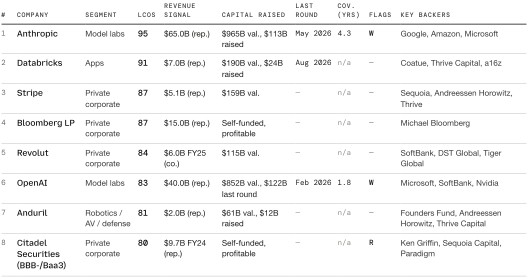
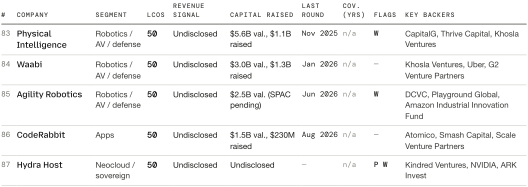
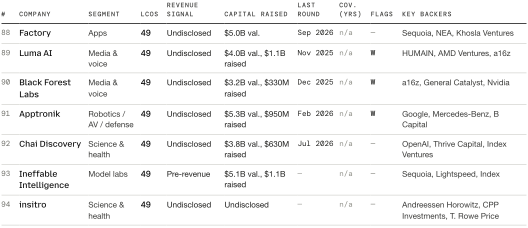
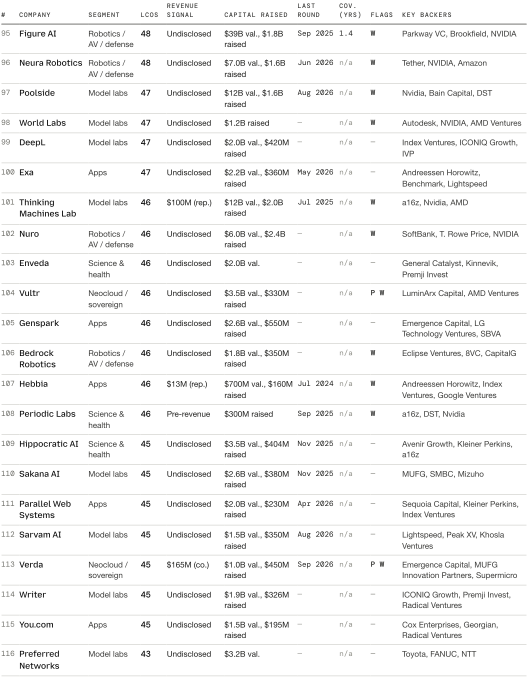
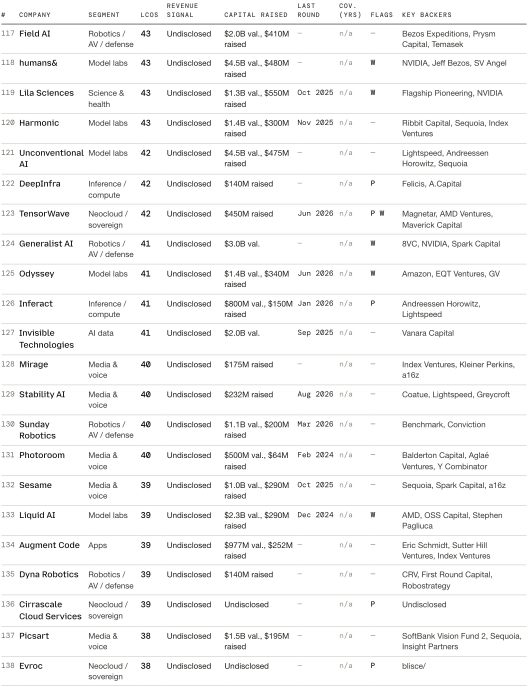
Revenue signal: co. = company-disclosed, rep. = credible press report, est. = third-party or analyst estimate. RAUM = regulatory assets under management, gross, from SEC Form ADV. Last round: most recent primary financing we could source; — = no sourced date, scored at the 12-to-24-month rate. Coverage: years of annual announced commitments, weighted by firmness, covered by the most recent round within 24 months; n/a = no commitments announced; * = total capital raised used, because no round date is sourced. Flags: R, E, P and W, as defined in the methodology. The same key applies to every tier table.
Tier 2
Strong, well-capitalized late-stage companies.
Thirty companies are bankable with modest support. Most have crossed $100M of revenue, raised in the last eighteen months, and carry at least one strategic or top-decile investor likely to fund the next round.
The tier mixes four kinds of counterparty. The first is the trading and investment firms, where the agencies and the model agree. The second is AI applications with real revenue and enterprise customers: Canva, Cognition, Harvey, Notion, Glean, Sierra, Lovable, Perplexity and Vercel. The third is compute intermediaries that are large offtakers themselves, led by Together AI, Nscale and Fluidstack, all of them pass-through names. The fourth is Waymo, whose credit rests on its parent, Alphabet, rather than on its own disclosed financials.
Jane Street is the clearest case. Fitch rates it BBB- (upgraded in July 2026), Moody’s Ba1 and S&P BB, the last two with positive outlooks. On our rule the middle rating, Ba1/BB+, sets its tier: a crossover credit with a positive outlook is exactly what Tier 2 means. Jane Street signed a reported $13B, five-year contract with Crusoe in September 2026, and Hudson River Trading signed a multi-year agreement with CoreWeave in August 2026 to train models on NVIDIA Vera Rubin systems. Hudson River Trading, Optiver, Jump Trading and XTX Markets score in the same band on the model. D. E. Shaw and Two Sigma are scored on their management companies and sit just below.
Two cases show why revenue alone is not enough. Mercor reports a $2B gross run-rate, but much of that passes through to contractors, so we count it at half. Fluidstack’s credit rests largely on its tenants, which include Anthropic, Meta and Jane Street, and on Google, which backstops certain of its decade-long leases. The sources we cite do not quantify those leases, so its coverage is shown as n/a.
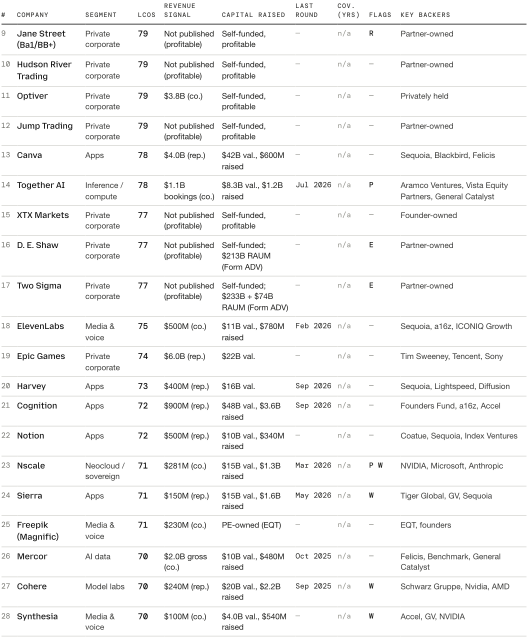
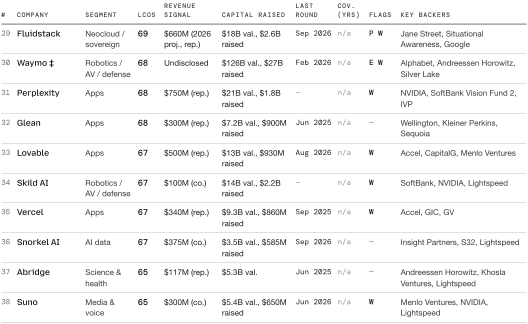
‡ Separately capitalized subsidiary of a public parent (Alphabet), included because it raises capital and contracts in its own name.
Tier 3
Solid growth-stage buyers.
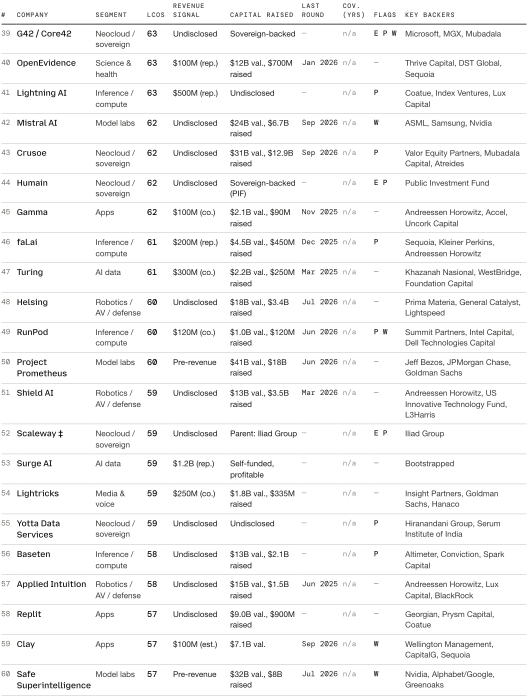
Forty-nine companies are bankable with real structure. This is the core of the private offtaker market: well-funded, often high-growth, but too young, too opaque or too committed relative to capital to carry a long tenor unsupported.
The tier is where capital and commitments diverge most. Reflection AI has announced up to $7.3B of compute, but a SpaceX contract worth up to $6.3B of it can be cancelled on 90 days’ notice after its first three months, so we count a quarter of that contract. Safe Superintelligence and Project Prometheus have large, recent rounds but no disclosed revenue. For all of them, the offtake is only as strong as the next funding round. The sovereign platforms, G42 and Humain, also sit here: their credit rests on state support that no one has committed in writing.
The inference platforms cluster here too: Baseten, fal.ai, Lightning AI, RunPod, Modal, Groq and SambaNova. They have fast revenue growth and top-tier backers, but they are resellers: their revenue depends on customers who can switch providers, and most buy capacity across many clouds rather than under one long contract. Modal’s valuation rose from about $1.1B to $4.65B in roughly a year, which says a lot about investor appetite and little yet about downside resilience.
Tier 4
Early-growth buyers that need heavy structure.
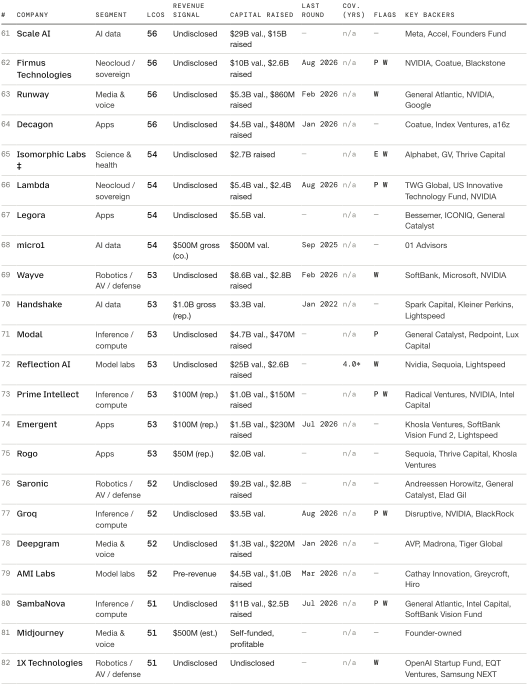
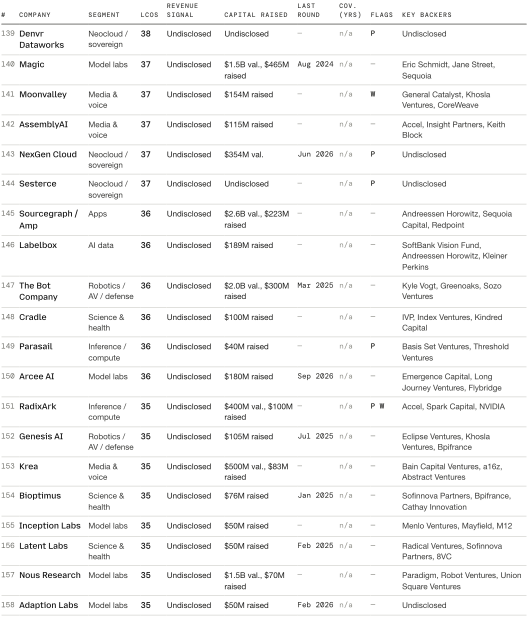
Seventy-one companies, the largest tier, can be served as offtakers only with significant protection. Most have raised $100M to $1B, disclose little or no revenue, and would be committing a large share of their balance sheet to a multi-year compute contract.
The tier holds many well-known names, which is the point. Several frontier and research labs raised large rounds in 2025 and 2026 on founder pedigree alone, and some have signed compute contracts larger than their equity. These are strong venture bets and weak unsecured credits. A lender should underwrite the cash in the bank and the sponsor’s willingness to support, not the valuation.
The tier also holds real businesses with little disclosure, including model developers and neoclouds that have operated for a decade or more. Better disclosure, even a revenue range shared under NDA, would move many of them up a tier.
Tier 5
Venture-risk offtakers.
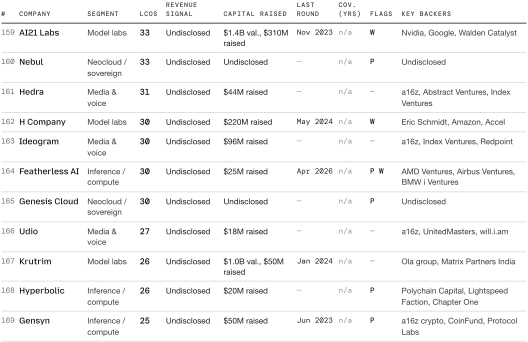
Eleven companies are best treated as a diversification slice inside a portfolio of stronger offtakers. A Tier 5 score says little about product quality or prospects; it says that public information cannot yet support an unsecured, multi-year compute obligation.
Three patterns explain most of this tier. The first is size: most companies here have raised under $100M, while a 1,000-GPU cluster on a three-year contract can cost several times that. The second is disclosure: several of the smaller neoclouds publish no funding or revenue figures at all. The third is business model: GPU marketplaces and decentralized networks aggregate other people’s capacity rather than committing to their own, so they are unlikely to sign a traditional offtake in the first place.
Structure flags
The balance sheet we scored is not always the one a lender faces.
The score describes one balance sheet, and for some companies that is not the one a lender would face. Seven carry an E flag because the entity that would sign an offtake is not the balance sheet we scored. Several pass-through names depend on tenants a lender may already finance. The table lists the support behind each, and anchor tenants where a cited source names them.
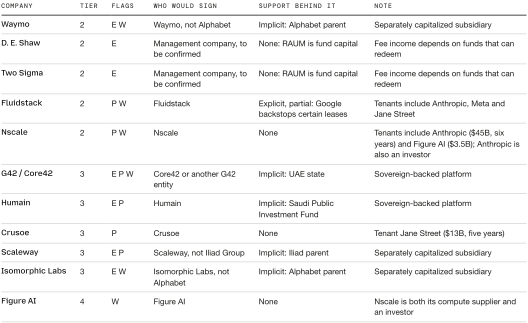
Fifty-six scored companies carry a W flag, most because NVIDIA or a hyperscaler is a key backer. OpenAI (Microsoft and NVIDIA) and Anthropic (Google, Amazon and Microsoft) are the largest cases: in both, the backers are also the main suppliers of compute.
Not scored
Thirty-one companies with insufficient public data.
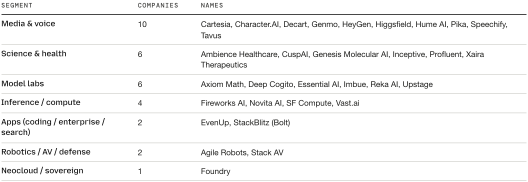
Thirty-one companies meet our criteria for the universe but carry no score, because we could not confirm their key figures from a live public source. Listing them without a score is a statement about the public record, not about the companies. Each one is covered by the right of reply: share figures with us under NDA and we will score it in the next edition.
What the ranking tells us
The best private offtakers are not the most famous AI companies.
Credit strength follows revenue, fresh funding and commitment discipline, and the frontier-lab brand does little on its own.
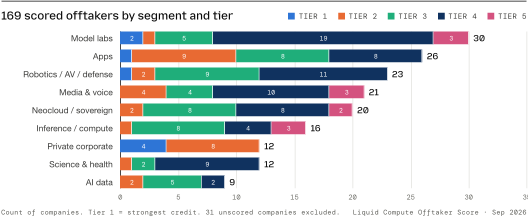
The strongest private buyers are hiding outside AI.
All twelve large private corporates we scored sit in Tier 1 or 2. Citadel Securities is the only one with an investment-grade rating; Jane Street’s ratings put it in Tier 2. Trading firms, Stripe, Revolut and Bloomberg have years of profits, need no new equity, and are now signing multi-billion-dollar compute contracts. Most GPU developers still pitch AI labs first.
Model labs are the most polarized segment.
Of 30 scored model labs, three reach Tier 1 or 2 and 22 fall in Tier 4 or 5. Anthropic and OpenAI can carry large offtakes; most of the rest are pre-revenue or undisclosed, however large their rounds.
Commitments are outrunning equity.
Figure AI’s $3.5B initial Nscale commitment is about twice its disclosed equity, and its latest round covers about 1.4 years of it. OpenAI’s announced deals, weighted by firmness, run to about $68B a year against $40B of revenue. Reflection AI’s headline $7.3B is mostly a SpaceX contract that can be cancelled on 90 days’ notice, which is why we count only a quarter of it. The offtake market is pricing the next round, not the balance sheet, and commitment coverage now carries 20% of the score.
Suppliers are also shareholders.
NVIDIA is one of the three key backers we list for 30 of the 169 scored companies, and Nscale took equity in Figure alongside its compute contract. Vendor equity helps a borrower raise money, but it is not a guarantee. Lenders should ask whether a strategic investor would actually step in on a missed payment. We mark these names W in the tables.
Your offtaker may not exist in a year.
While we built this list, more than a dozen candidates were acquired, listed or absorbed in 2026 alone, including Cursor (SpaceX), Hugging Face (NVIDIA, pending), Cerebras (IPO), OpenRouter (Stripe, reported) and Voltage Park (Lightning AI). Change-of-control and assignment clauses matter as much as the credit score at signing.
Disclosure is the cheapest credit enhancement.
145 of the 200 companies have no public revenue figure, and 31 have too little public data to score at all. A buyer that shares audited revenue, or even a range under NDA, can move up a full tier and pay less for its capacity.
Sensitivity
How sensitive the ranking is to the weights.
No company moves more than one tier under any of three alternative weightings, and 24 to 39 of the 169 move one tier. We re-ran the model to test whether the tiers are an artifact of our weights. This tests the weighting only, before rating overrides; the judgments behind business durability and track record stay fixed.

The largest swing is the trading firms: a revenue-led weighting lifts seven of them into Tier 1, one more reason we let agency ratings, not weights, decide their tier.
What the next edition adds
Five additions for the next edition.
Negative events
Down rounds, layoffs, missed payments, litigation and renegotiated compute contracts will count against track record; today it can only add points.
Backtest
We will run the model on companies that have already failed, been absorbed or renegotiated, and publish where it would have placed them.
Full sensitivity
A test of the judgments behind durability and track record, not only of the weights.
Re-leasing risk
A second rating beside the LCOS, covering GPU generation, region and whether the contract is assignable.
More rated anchors
As more offtakers carry agency ratings, we will set the tier cut-offs from them and drop the rescaling to a fixed distribution.
Limitations and disclaimers
Not a credit rating.
This report ranks companies from public information only. It is not a credit rating, investment advice or a recommendation to contract with, lend to or invest in any company named.
Public data only. We had no access to audited accounts, contracts or management, and we cannot see cash or burn. Private companies routinely share far more with counterparties under NDA, and a company’s real credit can be much stronger than its public profile.
Revenue figures vary in quality. Many figures are run-rates, bookings or gross revenue from press reports, not audited GAAP revenue. We label each one and haircut those we could not tie to the company.
Unscored companies. 31 companies whose key figures we could not confirm from a live public source are listed without a score and without figures.
Commitments and dates. Commitment coverage uses announced third-party deals only; own-build data-center spending is excluded. Four companies have announced deals we could quantify from cited sources; the rest score a neutral 65, so large private contracts are not reflected. Terms not disclosed are annualized over five years. We found a sourced last-round date for 89 of the 169 scored companies; the rest are scored at the 12-to-24-month rate.
Judgment factors. Backer depth, business durability and track record are analyst judgments scored 0 to 100 against the criteria above. For the self-funded trading firms, durability is set at one common level (lower for the two investment managers), so firm-specific events such as trading losses or regulatory actions are not reflected. Reasonable analysts would score some companies differently.
Calibration. Model scores are rescaled to a fixed distribution before the cut-offs apply; scores for the eight self-funded trading and investment firms are computed directly from the factor weights. Agency ratings override the model where they exist, and the two rated companies land in the same tier either way. We will replace the rescaling with rating-anchored cut-offs as more rated names become available.
Point in time. Data is current as of September 23, 2026. Several companies on this list have pending IPOs, SPACs or acquisitions (for example Nscale, Firmus, Agility Robotics and 1X), which would change their status and credit profile.
Scope. We excluded public companies, completed acquisitions and China-headquartered companies. Subsidiaries of public groups (marked ‡) are included where they raise capital in their own name.
Conflicts. Liquid Compute has commercial relationships with some companies on this list, including counterparties to transactions we have arranged or are arranging, and prospective partners. These relationships did not affect scoring, which follows the published methodology.
The right of reply at the front of this report applies to every company listed, scored or not.
Sources
Primary figures were drawn from company announcements, regulatory filings and reporting by TechCrunch, Bloomberg, Forbes, DatacenterDynamics, The Information, SiliconANGLE, BusinessWire and PR Newswire. Key sources for the figures cited in the text:
- Anthropic raises $65B at $965B valuation (TechCrunch, May 2026)
- Anthropic’s $45B compute deal with Nscale (TechCrunch, Aug 2026)
- OpenAI’s $122B funding round (TechCrunch, Mar 2026)
- The billion-dollar infrastructure deals behind the AI boom (TechCrunch, Feb 2026)
- Databricks company coverage (TechCrunch)
- Crusoe raises $3.9B, including the Jane Street contract (DatacenterDynamics, Sep 2026)
- Hudson River Trading’s multi-year agreement with CoreWeave (CoreWeave, Aug 2026)
- Figure and Nscale sign strategic partnership (Figure AI, Sep 2026)
- Reflection AI compute deal with SpaceX and with Nebius (TechCrunch, Jun and Jul 2026)
- Fluidstack valued at $18B (Forbes, Sep 2026)
- Together AI raises $800M (TechCrunch, Jul 2026)
- Mistral raises €3B (TechCrunch, Sep 2026)
- Cognition hits $48B valuation (TechCrunch, Sep 2026)
- Safe Superintelligence partners with Nvidia (TechCrunch, Jul 2026)
- Nvidia licenses Poolside’s model factory (Forbes, Aug 2026)
- Nscale IPO filing coverage (Seeking Alpha, Sep 2026)
- SpaceX to acquire Cursor for $60B (TechCrunch, Jun 2026)
- Hugging Face acquisition coverage (TechCrunch)
- Mercor valuation talks (TechCrunch, Jul 2026)
- D. E. Shaw & Co. Form ADV (SEC, Aug 2026)
- Two Sigma Investments Form ADV and Two Sigma Advisers Form ADV (SEC, Mar and Jan 2026)
- Microsoft, NVIDIA and Anthropic announce strategic partnerships (Anthropic, Nov 2025)
- AWS and OpenAI multi-year agreement (Amazon)
- CoreWeave agreement with OpenAI (CoreWeave, Mar 2025) and expansion by up to $6.5B (CoreWeave, Sep 2025)
- Agency ratings: S&P Global Ratings (BBB-, senior secured, 2026) and Moody’s (Baa3, term loan) on Citadel Securities; Fitch Ratings (BBB-, upgraded July 2026), Moody’s (Ba1, positive outlook) and S&P Global Ratings (BB, positive outlook) on Jane Street
The full company-level dataset, with a source link for every row, is available on request.